Share
"Accidental Education" Reality Lab
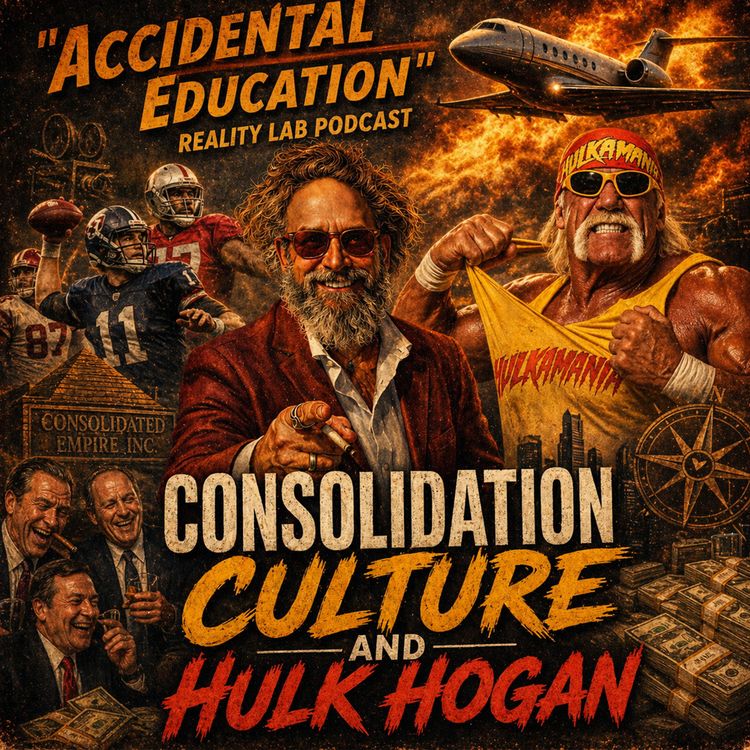
Consolidation Culture and Hulk Hogan
In this episode of Accidental Education: Reality Lab, Tom connects the dots between boardroom strategy, reality television chaos, college football realignment, and the unlikely cultural earthquake known as Hulk Hogan.
What starts as a look back at the era of mergers and acquisitions quickly turns into a full-blown safari through consolidation culture. From the airline shakeups following Ronald Reagan’s deregulation to modern giants like BlackRock and Vanguard Group turning homes into balance sheet entries, Tom breaks down how “growth” often comes with a hidden invoice paid by the consumer.
Drawing from his own career inside reality television, Tom gives a behind-the-scenes look at how creative, risk-taking shows—once powered by unknown personalities and unpredictable outcomes—were swallowed by large studios and repackaged into safer, celebrity-driven formats. It’s not that the machine doesn’t work… it’s that it works a little too well.
From there, the conversation shifts to college athletics, where the rise of super conferences like the Southeastern Conference and the Big Ten Conference signals a future where only a handful of programs can truly compete—and everyone else is left fighting for scraps or reinventing the game entirely.
And then comes wrestling—the ultimate case study. The collapse and absorption of World Championship Wrestling and Extreme Championship Wrestling into the World Wrestling Federation didn’t just end a war… it changed the product. Less edge. Less urgency. More control.
At the center of it all stands Hulk Hogan—the man who didn’t just ride the wave of popularity, he created it… and in doing so, helped usher in the very system that would eventually smooth out the chaos that made it great.
With sharp observations, dark humor, and a producer’s eye for patterns, Tom asks the question nobody in the boardroom wants to answer:
When everything gets bigger, safer, and more efficient…
what exactly are we losing?
This episode is a deep dive into the business of consolidation, the death of risk, and why the most dangerous thing in any industry might just be a “sure thing.”
#AccidentalEducation
#RealityLab
#ConsolidationCulture
#MergersAndAcquisitions
#LateStageCapitalism
#MediaConsolidation
#RealityTV
#CollegeFootball
#NIL
#SEC
#BigTen
#SportsBusiness
#HulkHogan
#ProWrestling
#CreativeEconomy
#RiskTaking
#ContentCreators
#EntertainmentIndustry
#PodcastLife
#BusinessBreakdown
See Privacy Policy at https://art19.com/privacy and California Privacy Notice at https://art19.com/privacy#do-not-sell-my-info.
Discover other shows on the Talk Red Podcast Network, and get your daily fix of news, sports, and entertainment at https://TalkRed.com.
DISCLAIMER: Some elements of this podcast may include AI-generated content, such as cover thumbnail images, show descriptions and some background audio.
More episodes
View all episodes
18. Victims, Revolutionaries and Witch Doctors | Accidental Education
01:06:29||Ep. 18In Episode 18 of Accidental Education: Reality Lab, Tom Cunningham explores the powerful force that shapes everything from personal interactions to political movements: narrative.The episode begins in Monrovia, Liberia, where a night of beers, bad decisions, and the world’s worst drinking game leads to a woman becoming convinced that Tom is a Juju Man. What follows is a hilarious lesson in how quickly perception can overpower reality when a story takes hold in someone’s mind.From there, Tom examines how technology has changed the way we see the world. Television once expanded our field of view, promising bigger windows into reality. Today, much of our lives are consumed through vertical screens that fit in our pockets. Has technology broadened our perspective, or quietly narrowed it?The conversation then turns to modern victim culture, social media outrage, and the incentives that reward conflict over solutions. When attention becomes currency, does victimhood become a business model?Finally, Tom takes a deep dive into one of the most fascinating stories in modern American history: Patty Hearst. Was she a kidnapped victim, a willing revolutionary, or something far more complicated? Decades later, the debate continues because the facts matter less than the narratives people attach to them.From Liberian Juju Men to social media algorithms, from public outrage to political extremism, Episode 18 examines the gap between reality and perception—and why the stories we tell ourselves often become more powerful than the truth itself.Because sometimes the most important question isn’t what happened. It’s what story people believe happened.17. Conformity, Gold and Empathy | Accidental Education: Reality Lab
01:01:48||Ep. 17What do $40 million in gold bars, Hollywood social climbing, and a dying camera craft have in common?Absolutely nothing.Which is exactly why we’re talking about all three.In Episode 17, Tom disappears down another rabbit hole with former CIA officer David Rush and the mysterious discovery of roughly $40 million worth of gold bars found inside his home. According to reports, the gold was acquired through legitimate CIA channels. Which naturally raises a few follow-up questions, such as:How?Why?And where exactly does one find a government form that says, “Check here if you would like forty million dollars in gold.”As always, the official story is likely to contain a mixture of truth, half-truths, omissions, footnotes, and enough bureaucratic fog to hide a battleship. Tom examines the strange case and explores the uncomfortable reality that the public often receives a version of events rather than the entire story. Somewhere between conspiracy theory and government press release lives a strange little neighborhood called reality.Then the conversation shifts west to Los Angeles, where Tom examines the bizarre political theater surrounding Karen Bass, Spencer Pratt, and the deeper psychology of conformity in America’s entertainment capital.Hollywood is a town built on rebellion that somehow became obsessed with fitting in.Actors want to be unique.Writers want to be original.Directors want to change the world.Yet everyone somehow ends up chasing the same approval, attending the same parties, repeating the same talking points, and hoping the cool kids let them sit at the table.Tom explores why conformity isn’t always evil. In many cases it’s simply the price of admission. Acceptance. Access. Status. Influence. Reputation. Belonging.Those are currencies just as valuable as cash. Finally, Tom takes a long look in the rearview mirror at the reality television business that shaped most of his adult life.Reality television isn’t completely dead.Far from it.There will always be unscripted programming.But something has changed.The wild frontier energy of the early 2000s has largely disappeared. The strange magic that made audiences feel like they weren’t watching television but accidentally spying on real life has become increasingly rare.The reason, Tom argues, comes down to a nearly forgotten filmmaking skill he calls:The Chaos Empath Method.Part camera technique.Part instinct.Part psychological. The Chaos Empath Method is the ability to absorb the energy of people, environments, conversations, danger, joy, conflict, and chaos, then translate those invisible vibrations through a camera lens and onto a screen.It’s the difference between watching an argument and feeling trapped inside it.The difference between seeing a celebration and feeling the room vibrate through your television.The difference between content and experience.Like cobblers, horseshoe farriers, and old-school craftsmen who knew things that couldn’t be taught in a classroom, Chaos Empaths are becoming increasingly rare in modern media.Today’s content is often technically perfect.The shots are sharp.The audio is clean.The lighting is beautiful.And somehow it feels about as emotionally nourishing as eating a rice cake in a hospital waiting room.If you’ve ever watched a show and wondered why it felt flat despite having every modern production advantage imaginable, it may be missing the secret ingredient.The camera was recording.But it wasn’t listening.Conformity.Gold.Empathy.Government mysteries.Hollywood psychology.And the lost art of capturing human energy.See Privacy Policy at https://art19.com/privacy and California Privacy Notice at https://art19.com/privacy#do-not-sell-my-info.16. Hollywood and War Propaganda Together Again | Accidental Education
01:04:46||Ep. 16This week Tom cannonballs straight into the deep end of the military industrial jacuzzi with a cocktail in one hand and a stack of unanswered questions in the other. Michael Bay is back, America is flexing again, and somehow a covert military operation that happened five minutes ago is already being transformed into a Hollywood blockbuster before the ink on the after action report has even dried.Bay’s newest project Operation Epic Fury feels less like a movie announcement and more like somebody accidentally hit “reply all” on a Pentagon group chat. The operation reportedly took place barely a month ago, yet somehow there’s already a book deal, a feature film deal, and enough momentum behind it to make seasoned Hollywood development executives spit bourbon across their keyboards. Mitchell Zuckoff hasn’t even finished writing the damn book and Michael Bay is already warming up the explosions, polishing helicopter shots, and probably test fitting aviator sunglasses on actors with suspiciously perfect jawlines.Tom starts pulling at the loose threads like a drunk guy at a casino slot machine convinced the whole thing is rigged. How does a project move this fast in Hollywood? Scripts usually die slower than mall food courts. Books sit in development hell longer than a timeshare presentation in Daytona Beach. Yet this thing got greenlit at warp speed like somebody at the highest levels decided the story needed to hit the public bloodstream immediately.Is this patriotism? Narrative shaping? Modern propaganda wrapped in Dolby Atmos and slow motion dust clouds? Is the Trump White House using Hollywood the same way governments have always used Hollywood: as a giant emotional support missile launcher for public opinion? Tom digs into the strange timing, the media choreography, and the uneasy marriage between warfare and entertainment that has existed since filmmakers realized explosions sell tickets and governments realized movies sell wars.Then the show slams the brakes into tragedy.Tom talks about the shocking and sudden death of beloved NASCAR driver Kyle Busch. One minute fans are watching him rip around the track on Sunday with engines screaming like chain saws trapped inside washing machines. The next minute, Thursday rolls around and notifications start lighting up phones across America like a digital air raid siren. Tom examines the facts emerging around Kyle’s passing, the conflicting reports, the speculation, and the emotional gut punch that comes when somebody larger than life suddenly becomes painfully mortal.It is less celebrity gossip and more a meditation on how bizarre modern life has become. We watch people in real time, follow them daily, hear their voices every week, and then suddenly they vanish from the timeline like a character written out of existence mid season.Finally, Tom descends into the sweaty jungle madness of Sorcerer and the filmmaking methods of legendary director William Friedkin. Not the polished Hollywood version of filmmaking where assistants hand actors cucumber water between takes. Tom is talking about the feral, mud covered, sleep deprived version where directors willingly drag cast and crew into psychological warfare against nature itself just to capture authenticity on film.Tom breaks down why Sorcerer remains one of the most criminally overlooked films ever made. A movie soaked in diesel fumes, sweat, paranoia, and the kind of tension that makes your teeth itch. Friedkin didn’t want actors pretending to suffer. He wanted suffering itself on camera. Bridges collapsing. Trucks dangling over jungle ravines. Men looking like they hadn’t slept since the Nixon administration. The film feels alive because everybody involved looked one heat stroke away from seeing God.That leads Tom into one of the most personal conversations he’s ever had on the show as he reveals the term he created for his own filmmaking philosophy:The Chaos Empath.A camera operator who doesn’t simply film environments but absorbs them. Somebody who walks into a riot, disaster zone, drug bust, refugee camp, swamp, back alley, hurricane, or war zone and tunes into the emotional frequency of the people inside it like a human antenna covered in bug spray and poor decisions.Tom explains how great unscripted cinematography is not about perfect composition. It’s about vibration. Energy. Rhythm. The invisible emotional static inside an environment. The smell of diesel fuel hanging in humid air. The exhaustion in a deputy’s eyes at 3 AM. The way fluorescent lights hum inside emergency rooms. The weird silence right before violence erupts. The feeling that the Earth itself is participating in the scene.Episode 16 becomes part war room, part conspiracy dive, part NASCAR wake, and part cinematic fever march through the jungles of Friedkin’s madness. Somewhere between Hollywood propaganda, stock car tragedy, and collapsing rope bridges in South America, Tom tries to answer a bigger question:Are we still watching stories unfold naturally…#AccidentalEducation#RealityLab#HollywoodPropaganda#MichaelBay#OperationEpicFury#WilliamFriedkin#SorcererFilm#ChaosEmpath#DocumentaryFilmmaking#CinemaVerite#WarPropaganda#MilitaryIndustrialComplex#BehindTheNarrative#Storytelling#UnscriptedTelevision#NASCAR#KyleBusch#FilmAnalysis#HollywoodMachine#MediaManipulation#ConspiracyCulture#PsychologicalOperations#FilmmakerLife#RealityTV #AccidentalEducationRealityLab#TruthVsNarrative#DirectorsCut#AmericanMythmaking#ChaosAndCamerasSee Privacy Policy at https://art19.com/privacy and California Privacy Notice at https://art19.com/privacy#do-not-sell-my-info.15. Psyop Season is Now Year Round
57:42||Ep. 15Another week in America, another seven days where reality feels like it was written by a sleep deprived writers’ room trapped inside a Buc-ee’s during a hurricane evacuation.This week, Tom broadcasts from the swamps, strip malls, graduation ceremonies, and psychological carnival rides of South Florida as he travels to celebrate his son’s graduation. What should’ve been a simple hotel check in somehow turns into a bizarre social experiment involving exhausted front desk workers, corporate hospitality weirdness, and the creeping feeling that everybody in America is being trained by the same malfunctioning customer service chatbot.Then Tom cannonballs directly into the radioactive deep end with the retirement of Ralf Baric For years, Baric’s name floated around the edges of the COVID conversation like a guy smoking cigarettes outside a casino who somehow knows way too much about maritime law and offshore banking. Tom digs through Baric’s long career, his research connections, Wuhan, gain of function studies, and the strange disappearing act of accountability that followed the 2020 pandemic. Was he a misunderstood scientist? A convenient scapegoat? Or just another highly intelligent man who accidentally opened the world’s largest can of bat flavored soup? Tom follows the breadcrumbs through academia, media spin rooms, and the beautiful taxpayer funded labyrinth known as modern science.Then comes Hantavirus, the disease so horrifying that even the usual pandemic drumline seems hesitant to put it on the summer concert schedule. Tom breaks down why a virus with an eye watering mortality rate might be the one thing even professional fear merchants won’t fully roll out for public consumption. Because there’s a difference between “flatten the curve” and “Dear God, nail the windows shut and start rationing canned peaches.”Next up, the shooting involving streamer Chud the builder becomes the launching point for a bigger conversation about America’s addiction to viral outrage, livestream chaos, and tragedy monetization. Tom examines the rise of content creators chasing conflict like prospectors hunting gold in a collapsing society. Every protest now has ring lights. Every street fight has sponsorship opportunities. Every emotionally unstable lunatic with a smartphone thinks they’re one viral clip away from a crypto deal and a podcast appearance. Tom asks the uncomfortable question hanging in the humid air like cigarette smoke at a Florida VFW hall: are we being psychologically conditioned for another summer of riots, division, and algorithm fueled madness like 2020?Finally, Tom takes a hard look at the death of Michael Mott, the man struck and killed by a Frontier Airlines jet. Tom dissects the media narrative machine and how quickly public sympathy evaporates once authorities hand the audience an “unsympathetic character.” Criminal history? Check. Troubled past? Check. Case closed. America shrugs and moves on to celebrity boxing highlights and raccoon TikToks. Tom examines how storytelling itself has become crowd control. Because if you want uncomfortable questions to disappear, sometimes all you have to do is convince the public the victim was too messy to matter.It’s another episode filled with conspiracies, media manipulation, pandemic ghosts, internet chaos merchants, hotel weirdness, and enough psychological whiplash to make a CIA intern spill his Celsius energy drink.Welcome to modern America.Where Psyop Season no longer has an offseason.#AccidentalEducation#RealityLab#PsyopSeason#PsyopSeasonIsYearRound#TomCunningham#GainOfFunction#COVID19#WuhanLab#PandemicPolitics#Hantavirus#MediaManipulation#NarrativeControl#ChudTheBuilder#ViralCulture#LivestreamChaos#AlgorithmNation#FrontierAirlines#MichaelMott#TrueCrimeCulture#ConspiracyCulture#PatternRecognition#ChaosAndComedy#VulgarLushStyle#SouthFloridaStories#InternetMadness#ModernAmerica#PsyopsAndPancakes#BoatsBeersAndBreadcrumbs#TheSimulationIsGlitchingSee Privacy Policy at https://art19.com/privacy and California Privacy Notice at https://art19.com/privacy#do-not-sell-my-info.14. Where’s Bum Farto? | Accidental Education
56:07||Ep. 14Another week in America means another week where reality feels like it was written by a sleep deprived screenwriter locked in a bunker with three energy drinks, a conspiracy board, and a stack of expired Blockbuster memberships. Thankfully, Tom Cunningham is here to guide you through the madness with the calm confidence of a man who’s filmed police raids, war zones, reality dating disasters, and airline passengers fighting over seat assignments like raccoons battling over a churro in a Walmart parking lot.This week, Tom dives headfirst into the growing chatter surrounding the Andes strain of Hantavirus and asks the question hanging in the humid air like cigarette smoke in a Key West dive bar: are we about to do the lockdown hokey pokey all over again? Tom breaks down the eerie similarities between the early media coverage of COVID-19 and the current handling of this potential outbreak. The language. The panic. The experts. The graphics. The dramatic music underneath local news anchors trying to pronounce scientific terminology like they’re auditioning for CSI: Boise. Tom also shares a deeply personal story about his own daughter’s terrifying battle with Hantavirus back in 2009, giving the conversation a grounded human perspective beneath the media circus.Then it’s time to raise a cocktail glass to one of America’s great eccentrics, media pirates, and yacht racing madmen: Ted Turner, Tom pays tribute to the broadcasting outlaw who turned cable television into a global force while simultaneously collecting baseball teams, championship wrestling, news networks, and America’s Cup trophies like a wealthy uncle with untreated ADHD and unlimited fuel points. From the rise of the Atlanta Braves to the beautiful chaos of World Championship Wrestling. Tom makes the case that without Turner’s willingness to bankroll bodyslams and bleach blond maniacs screaming into microphones, modern wrestling as we know it might not even exist. No Turner. No Monday Night Wars. No empire sized WWE machine printing money while grown men argue online about finishing moves.Next, Tom prepares passengers for final boarding on the unbelievable rise and turbulent crash landing of Spirit Airlines. From humble beginnings as a small Midwestern trucking company to becoming the internet’s favorite punching bag, Spirit evolved into something far bigger than an airline. It became a floating reality show at 35,000 feet. A yellow airborne social experiment where bachelor parties, emotional support peacocks, TikTok meltdowns, casino addicts, exhausted parents, and shirtless men named “Tank” all collided in the great American pressure cooker known as Gate C17. Tom explores how razor thin margins, social media dogpiles, operational chaos, and the internet’s addiction to outrage all helped send the airline into a nosedive despite an impressive safety record. Because in modern America, going viral for people calmly arriving on time doesn’t pay the bills.Finally, Tom takes listeners deep into the sunburned fever swamp folklore of Key West with the bizarre unsolved mystery of missing fire chief Bum Farto. A story so absurd it sounds less like true crime and more like Hunter S. Thompson got trapped inside an episode of Miami Vice after drinking paint thinner. Tom walks listeners through the early days of Operation Conch, where undercover narcotics cops disguised themselves as karate enthusiasts in a tropical wonderland populated by smugglers, hustlers, murderers, disco era kingpins, wandering parrots, questionable mustaches, and enough cocaine to stun a battalion of circus elephants. Add in political pressure from Florida’s governor, federal investigations swirling through the islands, and the mysterious disappearance of Bum Farto himself, and you’ve got one of the strangest unsolved stories in American history. Fifty years later, the question still lingers over the Keys like humidity and rum fumes: Where the hell is Bum Farto?#AccidentalEducation#RealityLab#WheresBumFarto#BumFarto#OperationConch#KeyWestMystery#FloridaFolklore#TrueCrimePodcast#ConspiracyCulture#Hantavirus#AndesStrain#MediaMadness#TedTurner#WCW#SpiritAirlines#AviationCulture#OutlawAirlines#FloridaStories#ColdCaseFiles#VulgarLushStyle#RealityTVProducer#PodcastLife#HiddenHistory#AmericaGoneWeird#ChaosAndComedy#InvestigativeStorytelling#OnPatrolLive#BehindTheScenes#WeirdAmerica#PatternRecognitionSee Privacy Policy at https://art19.com/privacy and California Privacy Notice at https://art19.com/privacy#do-not-sell-my-info.13. Two Days in the Valley with the Man in the Mirror | Accidental Education Reality Lab
01:07:33||Ep. 13This episode kicks the saloon doors open somewhere between history class, a Hollywood backlot, and a dimly lit bar where bad decisions introduce themselves before you even order a drink.Tom starts at the White House Correspondents’ Dinner—affectionately rebranded as the Hinckley Hilton—where the ghosts of political obsession and fame-chasing still hover like secondhand smoke. From there, he dives headfirst into the strange, twitchy psychology of presidential assassins and would-be assassins—the kind of guys who look in the mirror and don’t just see themselves… they see destiny, headlines, and a very misguided shot at immortality.This isn’t just a history lesson—it’s pattern recognition with a hangover.Tom connects the dots between lone wolves, cult leaders, political machines, churches, and organizations. Not all bad. Not all evil. But all built on the same chassis: a power structure. Same engine, different drivers. And when the wrong personality gets behind the wheel? That’s when things go sideways at 100 miles an hour with no brakes and a trunk full of bad ideas. He draws a straight line from those personalities to today’s social media culture—where narcissism isn’t just tolerated, it’s got a blue checkmark and a content calendar.Then—hard left turn into the future.Tom breaks down The AI Documentary—a film that spends half its runtime telling you the robots are coming to eat your lunch, your job, and possibly your dog… and the other half suggesting they might actually help you build a better world while organizing your inbox. He expected a full-blown apocalypse briefing. What he got instead was a weirdly optimistic buddy-cop setup: humans and AI, mismatched partners, learning to coexist without blowing up the precinct.And just when things get too existential, Tom does what any sane man does—he rewinds to the 90s.Enter Two Days in the Valley.This is where the episode loosens its tie, pours a drink, and leans back. Tom celebrates the lost art of the ensemble cast—where characters bounce off each other like barroom billiards and every subplot has teeth. He dives into performances from Charlize Theron, James Spader, Jeff Daniels, Eric Stoltz, Teri Hatcher, and Danny Aiello—a lineup that feels like a perfectly mixed cocktail: strong, unpredictable, and guaranteed to leave a mark.He breaks down what modern filmmaking lost when it traded character chemistry for spectacle. Back then, actors didn’t just share scenes—they hunted together, circling moments, building tension, dragging the audience into something messy and human.Bottom line?This episode is about the man in the mirror—whether he’s chasing power, fame, control, or just trying to figure out if the machine he built is going to help him… or replace him.It’s history, psychology, Hollywood, and a little bit of barroom philosophy—all shaken, not stirred, and served with a side of uncomfortable truth.Pull up a chair. Watch your drink. And maybe… don’t trust the guy staring back at you just yet.Tags#AccidentalEducation #RealityLab#NewEpisode #TomCunningham#AssassinationHistory #TrueCrimePodcast #PoliticalHistory #PsychologyOfPower #HumanBehavior #PatternRecognition #MediaLiteracy#Narcissism #SocialMediaCulture #PowerStructures #CultMentality #ModernSociety #CulturalBreakdown#ArtificialIntelligence #FutureOfAI #AIDebate #TechAndHumanity #AIFuture#90sMovies #TwoDaysInTheValley #FilmBreakdown #CinemaTalk #EnsembleCast #HollywoodStories#DeepDive #Mindset #TruthSeekers #ThinkForYourself #StayCurious #Unfiltered #NoFilterNeededSee Privacy Policy at https://art19.com/privacy and California Privacy Notice at https://art19.com/privacy#do-not-sell-my-info.11. Rehab, Artemis, and Iran
54:08||Ep. 11This week on Accidental Education, Reality Lab, Tom pulls the curtain back on something a little more personal, a little less tinfoil, and a whole lot more human.His wife has been at the Betty Ford Center for seven months. Seven. Months. That’s not a pit stop, that’s a residency. That’s Cirque du Soleil for the emotionally exhausted. And before you start imagining a cocktail of fentanyl, broken childhoods, and shadowy demons whispering from the corners of the room… take a breath.Her vice of choice? Blue Moon.Yes. The Belgian-style wheat beer with a citrus garnish and just enough coriander to convince you it’s classy.Tom walks you through the reactions he gets when he drops the “seven months in rehab” line into casual conversation. You can watch the concern bloom across people’s faces like a slow-motion car crash. They’re bracing for heroin, for pills, for something that requires a hazmat suit and a priest. Then he says “beer,” and the tension collapses like a bad soufflé. You can almost hear the internal recalibration. Wait… we canceled brunch for this?Meanwhile, inside the rehab bubble, his wife catches friendly fire. Group sessions filled with people who’ve wrestled demons with names, faces, and court dates… and there she is, getting lightly heckled for showing up with a craft brew habit and a wedge of orange. It’s dark. It’s absurd. It’s also real.Tom doesn’t pull punches here. He gets into the psychology of it. The quiet dependency. The comfort of structure. The seductive idea that rehab isn’t just a reset… but maybe a permanent address. Because out here in the real world, there’s no group circle at 9am, no counselor gently guiding your emotional traffic. Just life, raw and unsupervised.And that’s where things start to get interesting.Because Tom, being Tom, can’t just leave it there. No, he takes a hard left turn at reality and draws a line from rehab… to space.Enter Artemis.The NASA moon mission. Sleek rockets, polished press conferences, inspirational music swelling like a Super Bowl commercial for human progress. We’re told it’s about exploration, about pushing boundaries, about the next giant leap.But Tom asks the uncomfortable question:Are we watching progress… or are we watching production?Because after decades of mixed messages, half-truths, and “trust us, we’ve got this,” Americans are stuck in a psychological holding pattern. We want to believe. We need to believe. But there’s that little voice in the back of the bar saying, “Haven’t I heard this one before?”And just when you think the ride can’t get any stranger… he pivots to Iran.The drumbeat sounds familiar. Assurances of quick resolution. Clean objectives. Limited engagement. It’s the same script we’ve seen before, just with updated graphics and a new cast of characters. If you squint hard enough, you can see the ghost of Iraq pacing in the background, shaking its head and lighting another cigarette.What ties it all together?Rehab. Moon missions. Nation building.Three wildly different arenas, all selling a version of the same promise:We’ve got a plan. Trust the process. Everything will be fine.And maybe it will be. Maybe it won’t.But Tom makes one thing clear, in that gravelly, seen-too-much voice of his:At some point, you’ve got to step outside the system, look around, and decide for yourself what’s real… what’s helpful… and what’s just really good marketing with a reassuring smile.Because whether it’s sobriety, space travel, or geopolitics…no one’s coming to save you with a perfectly wrapped solution.Not even with an orange slice on the rim.#AccidentalEducation#RealityLab#AccidentalEducationPodcast#PodcastLife#NewEpisode#RehabJourney#AddictionRecovery#Sobriety#RecoveryRealTalk#BettyFord#LifeAfterRehab#RecoveryHumor#Artemis#NASA#SpaceExploration#MoonMission#SpaceDebate#ModernSpaceRace#Iran#MiddleEast#Geopolitics#WarTalk#ForeignPolicy#HistoryRepeats#PatternRecognition#QuestionEverything#TrustTheProcess#NarrativeVsReality#ThinkForYourself#ControlledNarrative#ModernMythology#DarkHumor#RealTalk#LifeIsAbsurd#TruthWithHumor#NoFilter#BarstoolPhilosophy#MustListen#PodcastRecommendation#DeepDive#MindBlown#StayCuriousSee Privacy Policy at https://art19.com/privacy and California Privacy Notice at https://art19.com/privacy#do-not-sell-my-info.9. Do We Ever See The Whole Elephant?
29:02||Ep. 9In this episode, Tom dusts off the ancient parable of the blind men and the elephant, that old philosophical chestnut where everybody grabs a different part and swears they’ve cracked the code. One guy’s hugging a leg calling it a tree, another’s got the trunk yelling snake, and nobody stops to ask if maybe they’re all just drunk in the dark arguing about zoo animals. Tom takes that idea and launches it straight into orbit, applying it to America’s space program where everyone has a piece of the story but nobody seems to have the whole damn elephant.From there, we strap into the latest chapter of cosmic ambition, the Artemis program NASA gears up to circle the moon again like it’s checking on an old ex. Tom squints at the official narrative the way a Vegas card counter eyes a suspicious shuffle. He’s not saying it’s rigged, he’s just saying the deck feels warm. He breaks down the mission details, the messaging, the timing, and the little breadcrumbs that make the pattern recognition crowd start pacing the room like a nicotine-starved detective in a 1970s cop movie.And then, just when you think it’s all rockets and rhetoric, Tom zeroes in on something even stranger. Product placement. Inside a government spacecraft. Logos floating around in zero gravity like it’s the world’s most expensive Instagram post. Which raises the question nobody in the press conference wants to touch. When did NASA needing a sponsor like a NASCAR hood ornament? Are we exploring the final frontier or pitching ad space between oxygen tanks?It’s part philosophy, part skepticism, part late-night diner conversation that gets way too deep way too fast. Because maybe the real question isn’t whether we went to the moon or what Artemis is doing now. Maybe it’s this:Are we all just holding different parts of the elephant… arguing in the dark… while the thing quietly walks away?#AccidentalEducation#RealityLab#Episode10#BlindMenAndTheElephant#FullElephant#PerspectiveMatters#PatternRecognition#SpaceProgram#NASA#ArtemisMission#MoonMission#SpaceExploration#ConspiracyCulture#QuestionEverything#ProductPlacement#FollowTheMoney#MediaNarrative#TruthSeekers#StayCurious#ThinkForYourselfSee Privacy Policy at https://art19.com/privacy and California Privacy Notice at https://art19.com/privacy#do-not-sell-my-info.