Share
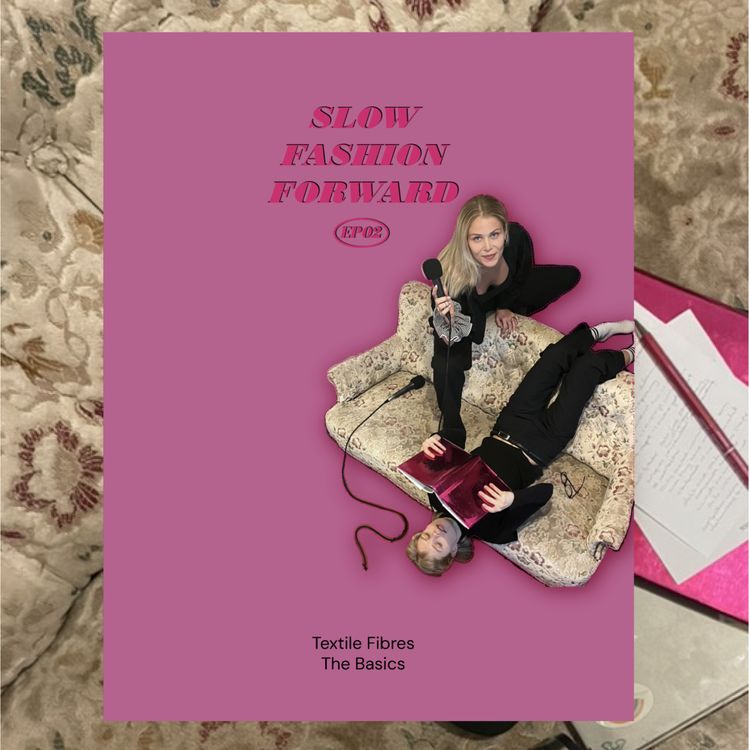
Slow Fashion Forward
Textile Fibres
Season 2, Ep. 2
•
What are our clothes actually made of? In this episode, Ebba and Sandra break down the basics of textile fibres—from natural to man-made. We explore where they come from, how they’re produced, and what that means for the planet. A perfect intro if you’ve ever wondered what lies beneath the surface of your wardrobe.
Sources mentioned and used in this episode include:
- Textiles by Sara J. Kadolph
More episodes
View all episodes
9. From Female Founders to Fashion Rentals with Anna Schleinkofer
34:45||Season 3, Ep. 9For our last episode this season, we speak with Anna Schleinkofer, co-founder of the podcast Einfachwomen and part of a fashion rental startup The Closet Lund in Sweden. From launching a podcast rooted in the female startup ecosystem to building a community-driven clothing rental platform, Anna shares her journey into entrepreneurship and what she’s learned along the way - realities behind starting something of your own, navigating uncertainty, and female entrepreneurship. This episode highlights the power of community, from women supporting each other in startup spaces to rethinking fashion consumption through shared wardrobes. This is a conversation about creativity, initiative, and why sometimes the best way to start… is simply to begin. Find Einfach Women here, listen to them here and check out The Closet Lund here. Thank you for joining us Anna!
8. Beyond Fast Fashion & Into Frequencies with Daniela Caine
46:54||Season 3, Ep. 8What if the way we create and wear clothes goes beyond materials and production and into energy, intention, and personal transformation? In this episode, Daniela Caine shares her journey from working within global fashion brands to stepping into a completely different way of thinking about fashion. After a turning point in her life, she began exploring the relationship between inner transformation and the systems we are part of, leading her to work with high-frequency textiles and conscious approaches to design.Together, we explore how personal growth can influence professional decisions, what it means to bring awareness into an industry built on speed, and how change might start from within rather than from external systems alone. This conversation moves between the individual and the collective, asking how fashion could evolve if we rethink not only what we produce but how we show up in the process.Make sure to check out Daniela’s brand here and more of Daniela’s work here. Thank you for taking part Daniela!
7. Consumption, extraction & limits with Earth
01:11:23||Season 3, Ep. 7An episode dedicated to earth as guest, but filled with our own opinions. And lots of opinions on the westerns and european culture, consumption and how we are taking and taking without giving back. Can you hear the rage, the frustration? Did you miss our opinions? What would Earth say if it could speak back to us?This episode is a reflection—part conversation, part release—on the realities of consumption, extraction, and the systems we continue to participate in. Without a traditional guest, we turn inward and outward at the same time, questioning the habits, structures, and cultural norms that shape how we live.From a Western and European perspective, we unpack what it means to constantly take without giving back, and the disconnect between awareness and action. There is frustration here, but also honesty—about the contradictions we live with and the responsibility we carry.This episode isn’t about offering clear solutions. It’s about sitting with the discomfort, naming the patterns, and asking what needs to change—on both a personal and systemic level.
6. Volunteering, Degrowth & Fashion Activism with Matthieu Thomas
01:00:15||Season 3, Ep. 6This episode’s guest is Matthieu Thomas, Country Coordinator at Fashion Revolution Sweden.With a background in corporate sustainability, Matthieu has moved into a volunteer-led global movement advocating for transparency and accountability in fashion. He shares what it means to rethink the industry beyond profit and growth, and why degrowth is becoming an increasingly relevant question.We also revisit the impact of the Rana Plaza collapse, and how it became a turning point for global awareness and the founding momentum behind Fashion Revolution. The conversation explores degrowth in fashion, the realities of working in sustainability between purpose and burnout, and how systemic change actually happens in practice. We also look at how global movements operate locally, and why collaboration, not perfection, is essential for progress. From systemic critique to personal responsibility, this episode asks what it really takes to create meaningful change in an industry built on constant growth.Find Fashion Revolution Sweden here and join us for Fashion Revolution Week (20-26th of April):Swap event (Stockholm) Friday 25th of April 13:00-16:00Algae Workshop (Stockholm) Thursday 23rd 17:00-20:00More event in Gothenburg and LundCheck out your local Fashion Revolution website for events in your city.
5. Innovating Fashion from Lab to Consumer with Nina Canova
57:15||Season 3, Ep. 5Discover how sustainable fashion moves forward with the second co-creator of Materials for Future - Nina CanovaIn this episode, we explore life cycle assesments (LCAs), the role of interdiscplinary science communication within sustainability and the reality of EU-centric regulations within textile waste management. Nina shares her interdisciplinary experience as a materials scientist who is passionate about bridging science with art through biodesign, and community building.Check out Materials for future and make sure to follow them on substack, linkedin and instagram!
4. Next-Gen Textiles with Guoda Treciokaite
54:18||Season 3, Ep. 4What if textiles could be grown, not made?What if the future of fashion doesn’t start in a factory but in a lab, a kitchen, or a community workshop?In this episode, we sit down with Guoda from Materials for Future to talk bio design, algae yarn, kombucha leather, and what it really takes to build next-gen materials in today’s world. Is community just as important as innovation itself? From silkworm architecture to seaweed tampons and the reality of scaling sustainable innovation, this is a conversation about rethinking materials and the systems behind them. Because maybe the future of fashion isn’t just about new fibers, maybe it is about community, and creating change without burning out.Check out Materials for future and make sure to follow them on substack, linkedin and instagram!
3. Turning Denim into Wood with Lill O. Sjöberg
48:41||Season 3, Ep. 3What if discarded jeans could become a new material?In this episode, Lill O. Sjöberg, founder of TWOOD, who accidentally turned textile waste into a material that behaves like wood guests SFF. What started as an experiment with denim waste quickly evolved into a material innovation made from discarded jeans.Lill shares how working closely with textile waste reshaped her perspective on the fashion industry, why aesthetics and emotional value matter in sustainable design, and what it takes to develop a new material as an independent designer.Learn more about Lill, TWOOD and Twalli Mentioned in this episode:https://skryta.se/https://www.thenewdenimproject.com/https://wargoninnovation.se/en/ https://www.ri.se/en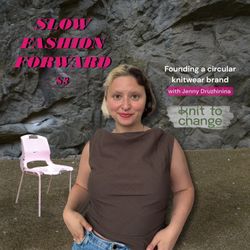
2. Knitting Change with Jenny Druzhinina
42:14||Season 3, Ep. 2Jenny Druzhinina, co-founder and creative director of Knit to Change, shares how a personal battle with depression turned into a circular knitwear project empowering refugee women in Berlin. Using donated yarn from industrial yarn suppliers, the brand creates bold, handcrafted pieces while paying fair hourly wages that challenge fast fashion’s production model. This episode explores what it truly means to build a purpose-driven fashion brand, touching on post-Soviet craftsmanship, Berlin Fashion Week and using AI as a creative tool. Thank you Jenny for joining us and for making fashion Slow <3Check out Knit to Change´s handcrafted pieces and make sure to follow them on instagram!
1. A Long Distance Catch Up
48:28||Season 3, Ep. 1A new season begins! Ebba and Sandra catch up across continents, reflecting on the past months, self-awareness, and slow habits while navigating life, studies, and planning the new podcast season. From Costa Rica’s pesticides and earthquakes to mindful routines and fresh mindsets, this episode sets the stage for a season full of new perspectives, featuring guests from across the fashion and sustainability space, recorded between Berlin and Costa Rica.Find us on Instagram, Linkedin and TikTok 🩷