Latest episode
Opportunity Zones 2.0 (Part 2/2)
41:02|In part two of this conversation, Terry Cook and Nick Rosenthal move from the mechanics of the new law into the planning decisions that follow. They walk through how census tract redesignations work and what the next cycle of zones might look like, explore the Rural Opportunity Fund provision and who it actually serves, and use the Laurel Apartments project in East Austin as a real-world example of what success looks like in this program. They also cover how Opportunity Zone investments sit alongside installment sales, charitable structures, 1031 exchanges, and tax-loss harvesting strategies and close with the investment questions that matter most before committing capital. 0:45 – Census tract redesignations: what the next cycle of zones might look like5:57 – Rural Opportunity Funds: what changed, who it's for, and how Griffin thinks about it11:25 – A Washington state footnote: solar and wind farms as rural OZ examples15:09 – The Laurel Apartments, East Austin: what the program looks like when it works18:06 – How refinancing events and operating distributions work during the hold period22:38 – Why the long-term tax-free growth is the headline, not the deferral26:32 – How Opportunity Zones work alongside installment sales, 1031s, and charitable structures32:00 – Why real estate belongs in a post-sale portfolio, the investment argument35:01 – The tail cannot wag the dog: how Parcion evaluates OZ fund quality35:54 – Questions every sophisticated investor should ask before committing capital39:00 – The single mindset shift Nick wants business owners to walk away with
More episodes
View all episodes
Opportunity Zones 2.0 (Part 1/2)
26:34|Join Terry Cook as he speaks with Nick Rosenthal, co-CEO of Griffin Capital, to walk through what changed in the Opportunity Zone program on July 4th, 2025, and why it matters for business owners preparing for a sale. Nick shares how permanence transforms the planning conversation, how the rolling five-year deferral and restored basis step-up work together, and what a disciplined, investor-aligned approach to Opportunity Zone funds actually looks like. Tune in to understand one of the most significant updates to the tax code for business owners in years.2:42 – Who is Griffin Capital and what do they focus on6:27 – Co-investment alignment: $300 million of leadership capital alongside investors8:18 – Plain-English explanation of how Opportunity Zones work9:46 – The origins of the program and whether it has delivered on its promise13:12 – Criticism of the program and how Griffin evaluates the spirit versus the letter17:13 – The five changes that matter most: starting with permanence21:49 – The rolling five-year deferral clock and why it democratizes timing25:24 – The restored 10% basis step-up and how it pairs with passive loss strategies28:38 – What to expect in Part 2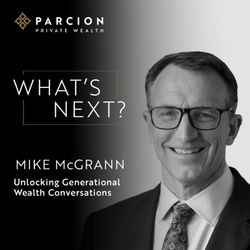
Revisited: Unlocking Generational Wealth Conversations
49:55|In this episode of What's Next? from Parcion Private Wealth, host Terry Cook and guest Mike McGrann, from the Fidelity Center for Family Engagement, discuss legacy preservation and wealth communication. They tackle fears surrounding wealth's impact on future generations and strategies for constructive family dialogue. As a subject matter expert on families of wealth and family-owned firms, Mike shares insights on maintaining healthy relationships around wealth, emphasizing the importance of open communication to prevent misunderstandings and conflicts. If you are interested in learning more about how Parcion can support your generational conversations, please contact us at info@parcionpw.com or visit www.parcionpw.com.
AI Implementation for Business Owners with Natalie Pierce
46:46|Join Terry Cook as he speaks with Natalie Pierce, a leading expert in AI and partner at Gunderson Dettmer. Discover how business owners and leaders can harness the power of AI to transform their operations, enhance efficiency, and stay competitive. Natalie shares insights on generative AI, the importance of prompt engineering, and best practices for AI adoption in the workplace. Tune in to explore the future of AI in business.If you are interested in learning more about how Parcion can support you, please contact us at info@parcionpw.com or visit www.parcionpw.com.00:54 – Episode introduction1:30 – Natalie Pierce explains her role at Gunderson Dettmer and her expertise in AI3:20 – What is Artificial Intelligence? What isn’t it? What is Generative AI?6:08 – Generative AI versus Machine Learning10:20 – Training a workforce to use this technology12:50 – Prompt engineering and upskilling the workforce18:40 – The dark side of AI, including cybersecurity threats and deep fakes21:30 – Explanation and importance of a closed enterprise solution24:45 – Best practices and examples for business owners implementing AI31:15 – Augmented versus virtual reality33:50 – Cobots and their use38:40 – Considerations for employers deploying general or HR AI powered tools42:00 – Contact information for Natalie Pierce and further resources2. Unlocking Generational Wealth Conversations with Mike McGrann
49:24||Season 2, Ep. 2In this episode of What's Next? from Parcion Private Wealth, host Terry Cook and guest Mike McGrann, from the Fidelity Center for Family Engagement, discuss legacy preservation and wealth communication. They tackle fears surrounding wealth's impact on future generations and strategies for constructive family dialogue. As a subject matter expert on families of wealth and family-owned firms, Mike shares insights on maintaining healthy relationships around wealth, emphasizing the importance of open communication to prevent misunderstandings and conflicts. If you are interested in learning more about how Parcion can support your generational conversations, please contact us at info@parcionpw.com or visit www.parcionpw.com.1:00 – Episode introduction 2:52 – Addressing the fear of money ruining kids by utilizing better conversational tools4:45 – Creating distance with hierarchical behavior 8:20 – Statistics around wealth transfer10:00 – Defining what "Legacy" means to you 13:20 – Using intentional reflection to define your legacy and relationship to wealth14:00 – Intended and unintended outcomes and consequences15:40 – Voice versus vote16:00 – Peership and commitment to mutuality 18:40 – Real life example of a conversation about wealth with a 14 year old around shoes21:40 – Real life example of a conversation about wealth with estate planning and family dynamics25:03 – Fair versus equal29:20 – Wish versus fear 32:00 – Developing a healthy respect for wealth in your children36:22 – Takeaways and strategies for constructive family dialogue44:25 – Fidelity Center for Family Engagement's mission and passion to support family businesses1. How to Use Employee Stock Ownership Plans (ESOPs) to Optimize Your Business with Ted Lape
36:20||Season 2, Ep. 1In this episode of What’s Next?, host Terry Cook is joined by Ted Lape of Lazear Capital Partners to discuss ESOPs, a tool commonly used to facilitate succession planning, allowing a company owner to sell their shares to support their goals and transition flexibly out of the business. Ted has an impressive 30-year history in the banking industry and has helped many clients with setting up an ESOP at their company. More information about ESOPs can be found in our whitepaper “How to Successfully Exit Your Business with an Employee Stock Ownership Plan (ESOP)” available on our website www.parcionpw.com or at www.lazearcapital.com/.1:35 – Ted’s introduction to ESOPs2:44 – What is an ESOP?3:30 – How are ESOPs different from ESPPs (Employee Stock Purchase Plan) or other employee stockownership plans?5:30 – Mechanics, steps, and benefits of ESOPs, timeframe7:55 – How is an ESOP different from a direct sale?13:20 – Advantages14:20 – Disadvantages14:58 – Example when ESOP is the right solution18:40 – Financing options and involvement24:40 – Why don’t more business owners choose to exit with an ESOP?26:20 – Cost and professionals involved30:50 – How an ESOP can help ensure a legacy for a business ownerAn Intro to the Stanford Seed Program with JoAnna Halk and Mark Phelps
41:16|In this episode of What’s Next?, JoAnna Halk, an associate director for the Stanford SEED Program, and Mark Phelps, a retired serial entrepreneur and Stanford SEED coach, join host Terry Cook to discuss the benefits of the SEED program, the unique opportunities it presents to business owners, and effect that it’s had on participating companies across Africa and Southeast Asia. More resources at www.parcionpw.com and https://www.gsb.stanford.edu/seed.