Share
Sketchplanations - The Podcast
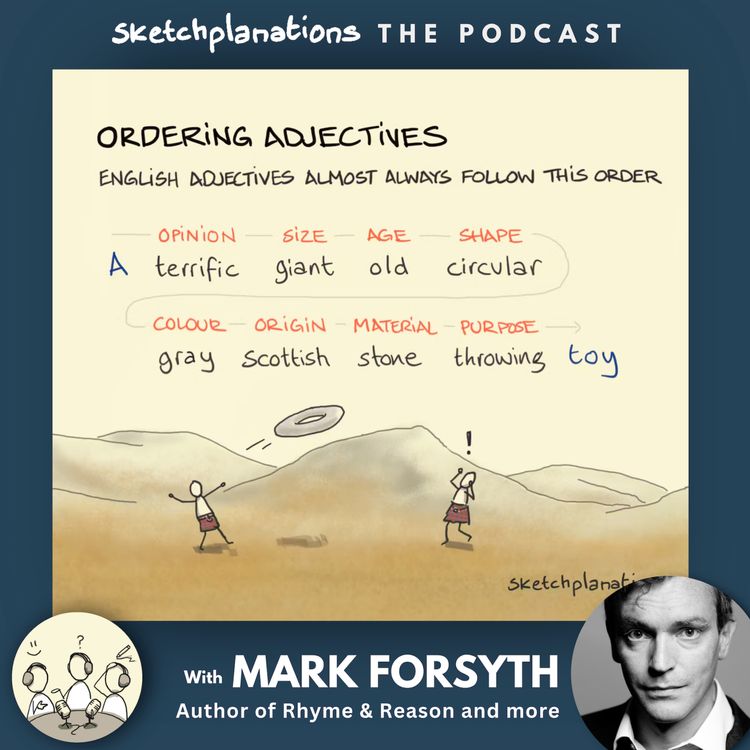
Ordering Adjectives with Author Mark Forsyth
When describing something with numerous adjectives (eg. the big brown dog, the heavy square steel door) there's a natural order we all instinctively follow as english speakers. I don't remember ever being taught it, nor would I be able to explain it to you, but my ear can definitely tell if someone gets it wrong!
English adjectives follow a specific order. Who Knew?!?
Well, there's one person for sure:
What our special guest on this episode, award-winning author, journalist, and etymologist, Mark Forsyth, doesn't know about the English language, simply isn't worth knowing.
In our conversation, Mark breaks down the correct traditional ordering of adjectives. And Mark's passion for the English language becomes clear as he walks us through other nuances of English, such as Ablaut Reduplication (why it's Zig Zag and Splish-Splash rather than Zag-Zig or Splash-Splish), Chiasmus (inverting phrases in a speech eg. “Ask not what your country can do for you — ask what you can do for your country.” — John F. Kennedy, Inaugural Address (1961)) and many more.
Additionally, in celebration of Mark's latest book; "Rhyme and Reason : A short history of Poetry and People (for people who don’t usually read poetry)" we talk about the history of poetry and its impact on readers from medieval times to the present. We learn how poetry was once widely shared and enjoyed socially (a bit like sharing memes on social media today) and how English has natural cadences and rhythm to it, that we all make use of every day - again, without having a clue that we're doing it. And we also learn why most of us have been thinking about poetry all wrong ever since school.
In the episode, we also reference Mark's other books such as The Etymologist and The Elements of Eloquence, which can all be found here.
And you can follow Mark's musings and love of language on his blog as The Inky Fool, on Twitter, and on Instagram.
Episode Summary
00:00 Welcome & Introduction to Mark Forsyth: Wordsmith Extraordinaire
01:05 Mark Forsyth's Journey with the English Language
01:44 The Fascinating World of Words and Their Origins
02:27 Mark Forsyth's Books and Their Unique Insights
06:32 The Popularity of Poetry Through the Ages
11:06 The Decline of Poetry and Rise of Pop Lyrics
12:48 Exploring English Syntax and Adjective Order
15:03 The Intricacies of English Grammar
21:38 Fun with Language: Reduplication and Compounds
27:38 Rhyme and Reason: Poetry in Society
29:27 The Unsung Heroes of Songwriting
30:42 The Evolution of Poetry's Popularity
41:33 The Rhythms of English Language
50:54 The Charm of Limericks
54:49 The Joy of Reading Poetry Aloud
56:45 Closing Thoughts and Farewell
All music on this podcast series is provided by the wonderfully talented Franc Cinelli.
More episodes
View all episodes
12. Hitting the Target: Accuracy vs. Precision
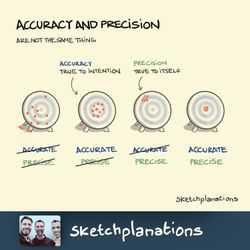
29:44||Season 5, Ep. 12Using Jono’s sketch of four archery targets, we discuss why and how accuracy and precision differ.Using many different examples, we frame the distinction as “accuracy being true to intention and precision being true to itself,” also phrased as doing the right thing versus doing it right.The sketch is inspired by Simon Winchester's book, Exactly, where precision and accuracy are connected to the industrial revolution via Henry Maudsley’s innovative screw-cutting lathe, micrometer, and the concept of interchangeable parts. The conversation broadens to explore examples in food (McDonald’s vs artisan meals), recipes, recruiting, IQ tests (validity vs reliability), indoctrinated beliefs, gut feelings, culture’s return to individual craftsmanship, AI’s variable answers, LED mask wavelength tolerances, and targeting weapons.External linksAlso referenced in this episode:Jono's sketch that describes the difference between Reliability and Validity.Jono's sketch inspired by Roger Martin's Knowledge Funnel.Jono's sketch outlining The Beard Cycle.Episode Outline00:00 Accuracy vs Precision: the Four Target Sketch03:23 True to Intention04:11 Ball Through Window05:44 Precision Built World09:45 Food and Recipes13:27 Calibration and Scales14:47 Manufacturing Tolerances16:51 Hiring and Testing19:16 Beliefs and Education23:01 Culture and Craft26:09 Doctors Robots and AI29:03 Wrap Up and CreditsAll music on this podcast series is provided by the very talented Franc Cinelli and you can find more tracks at franccinelli.com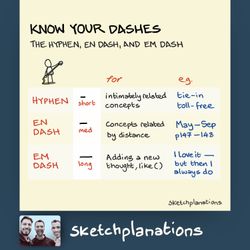
11. Do you Know Your Dashes?
33:19||Season 5, Ep. 11If you like the finer details of grammar and punctuation, then you're gonna love this episode.We geek out on the subtle, but incredibly important and occasionally crucial differences between three little horizontal lines: the hyphen - the En Dash – and the Em Dash —Jono explains hyphens for line breaks and compound terms, how usage can evolve into single words (e.g., wildlife, wellbeing), and why hyphen placement can change meaning (e.g., five-dollar bills). The en dash is described as linking ranges and relationships (pages, dates, times, scores, routes, debates, partnerships, negotiations), with notes on how to type it. The em dash is framed as a stronger-than-comma interruption for added thoughts, with style cautions and typing methods. They discuss underscore origins from typewriters, punctuation differences across countries, and how AI popularized em dashes as a telltale sign of machine-written text.Most importantly though, we discuss why this matters and that if used correctly, they can help avoid misunderstandings.Episode Summary00:00 Welcome to Sketchplanations00:40 What Are Dashes03:09 Hyphen Basics04:32 Hyphenated Words05:35 Language Evolves07:00 Hyphen Pitfalls07:31 Tom on Hyphens10:38 Meet the En Dash11:41 Typing En Dashes12:32 En Dash Use Cases14:47 Spacing and Style15:30 Introducing Em Dash15:33 Em Dash Basics16:15 Style Guide Rules18:08 Brackets vs Speech18:57 Where Names Come From20:32 Underscore Origins22:05 Reading Dashes Aloud24:39 Does It Matter26:04 Oxford Comma Stakes28:36 AI Em Dash Tell29:59 Typing Em Dashes30:32 Punctuation By Country31:41 Morse Code And Minus32:43 Final Sign OffExternal LinkThere's only one link this week:Jono referenced the book Strunk and White : The Elements of StyleAll music on this podcast is provided by the very talented Franc Cinelli.
10. Digging Through the Planet: The Geography of Antipodes
17:22||Season 5, Ep. 10Have you ever wondered what's happening on the exact opposite side of the world to you?Wherever you are on our planet, there's a good chance you'd need a snorkel.In this episode, we explore the concept of antipodes—the exact point on the opposite side of Earth from wherever you're standing. We discover why most antipodes end up in the ocean rather than on land and cover a whole host of fascinating geographic facts, including how the Northern Hemisphere contains the vast majority of Earth's land and population, how map projections distort our view of the planet, and why Earth's oblate spheroid shape means some antipode distances are longer than others.Along the way, we also raise the big questions like how deep have humans ever dug into Earth and how long it would take to fall through a frictionless tunnel to your antipode.External Links and mentions on the show:Jono's sketch that explains the Mercator Map Projection Jono references the Antipodal Map in the book Marvellous Maps by Simon KuestenmacherThe 7.6 mile deep hole Jono talks about is the Kola Superdeep Borehole in Russia, initiated by Soviet scientists in 1970, primarily to better understand the earth’s crust. Here's Jono's sketch about the thickness of the earth's crust being proportionally similar to the thickness of an apple's skin. And finally, if you want to know your exact antipode, you can look here on AntipodeMap.comEpisode Summary00:00 What Are Antipodes03:23 Land Distribution on Earth04:14 Map Projections and Perspectives07:19 Antipodal Map Overlay08:56 Cultural References Worldwide10:15 Etymology of Antipode10:41 Digging Through Earth12:44 UK Antipodes13:29 Great Circle Routes14:20 Earth's Oblate Shape15:25 Tunnel Through Earth16:34 Closing RemarksAll music on this podcast series is provided by the very talented Franc Cinelli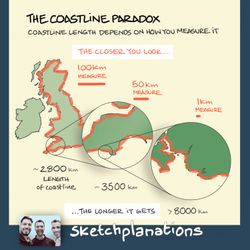
9. The closer you look, the longer it gets: The Coastline Paradox
26:04||Season 5, Ep. 9When you want to measure something you take your ruler or tape measure and read off the length right?But when it comes to measuring the length of a coastline, things get a bit tricky and totally counter intuitive. 🌊The science and maths of measuring wiggly coastlines reveal that the smaller the unit of measure, the longer the coastline becomes. Jono recounts the origins of this phenomenon from polymath, Lewis Fry Richardson and its further exploration by Benoit B. Mandelbrot. The trio also relate the concept to various other real-world examples, including the surfaces of the brain and lungs, Romanesco cauliflower, and stock market patterns. Additionally, they touch on the philosophical implications of measurement and delve into the concept of infinity.Episode Summary:00:00 Introduction the Coastline Paradox04:12 Historical Context and Discovery14:10 Fractals and Natural World Applications17:26 Modern Implications and Analogies24:36 Conclusion and Final ThoughtsExternal Links and mentions on the show:Jono refers to and leans heavily on the writing of Geoffrey West in his book "Scale" to tell the story of how this was discovered.Rob's half-baked fact about The Standardised Meter can be expanded on here.This is what the self-similarity of a Romanesco Cauliflower looks likeHere is the avenue of trees in Bushy Park, in Southwest London that Jono slalomed.Here are more facts on who originally defined the number 'zero' as we know it today.All music on this podcast series is provided by the very talented Franc Cinelli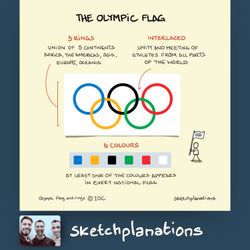
8. More Than Just Rings: Unity, History, and Ambition.
23:24||Season 5, Ep. 8Have you ever wondered what the colours on the Olympic flag represent?The Olympic logo is a globally recognised brand and remarkably, it was designed over 100 years ago by the founder of the modern Olympic Games, Pierre de Coubertin.This time, we discuss the history and symbolism of this design icon ahead of the Winter Olympic Games in Milano Cortina, Italy. We find out about its representation of unity among the five (?) continents (one for each ring), and the careful selection of the flag's colours. The episode also delves into fascinating Olympic trivia, including the evolution of the games, historical moments, and the development of the Olympic motto. Rob also shares insights from filming at the Olympic Museum in Lausanne, Switzerland, for his series 'The Vault,' which explores Olympic history through artefacts found in their archives.You can watch all 10 episodes of The Vault for free here on the Olympics Channel.Episode Summary00:00 Introduction and Excitement for the Winter Olympics01:42 The Genesis of the Olympic Flag02:50 Symbolism and Design of the Olympic Flag05:06 Pierre de Coubertin: The Visionary Behind the Olympics05:21 Exploring Olympic History and Artifacts09:35 Evolution of the Olympic Games and Flag22:28 Conclusion and FarewellAll music on this podcast series is by the very talented Franc Cinelli.
7. Tsundoku: Do you buy books faster than you can read them? 📚🤔
20:48||Season 5, Ep. 7How big is that pile of books next to your bed?Tsundoku is a Japanese word for buying books and letting them pile up unread. It’s a familiar habit to book lovers everywhere — that growing stack of books you intend to read but haven’t yet. In this episode of Sketchplanations The Podcast, we explore why we buy books we don’t read, why unread books don’t always feel like a bad thing, and what this habit says about curiosity, identity, and our relationship with reading.In this episode we embrace Tsundoku and our conversation ranges from buying too many books to the joy and guilt of collecting unread books, and how tsundoku can extend to audiobooks, hobbies, and other unread things. If you’ve ever wondered why you buy books faster than you can read them — or felt conflicted about your own unread pile — this episode is for you.Links to items (mainly books) that we discussed:The book that changed Tom's life: Rocket Fuel by Gino Wickman and Mark WintersThe book from Jono's pile he next wants to start: A few short sentences about writing by Verlyn KlinkenborgRobbie is most looking forward to getting started on: Whatever will be will be by Felix WhiteJono recommends cartoons about books and reading by Tom GauldBig Ideas, Little Pictures is the Sketchplanations book by Jono HeySummary: 00:00 Introduction to Tsundoku: The Act of Collecting Unread Books02:52 Personal Stories and Reflections on Tsundoku05:20 The Broader Implications of Tsundoku07:49 Books as Gifts and Their Value10:03 The Joy and Guilt of Collecting Books17:14 Final Thoughts and Reflections19:34 Conclusion and FarewellAll music on this podcast series is by the very talented Franc Cinelli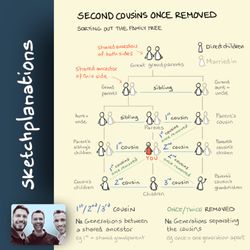
6. Family Tree Explainer
28:46||Season 5, Ep. 6Do you know who your second cousins are or if you even have any? And what does "once removed" mean anyway?Tune in to this episode as we unravel the mysteries of family relations—which we figured would be particularly helpful at the festive time of year.We explore the subtleties of family trees, making our way to 'Second Cousins Once Removed'. We dig into the confusion around generational terms and the importance of knowing your extended family. We share a few family-related anecdotes and cultural differences, such as the Chinese family tree and Icelandic naming conventions. We strongly encourage you to follow along with the sketch at Sketchplanations.com to better understand your own family connections.Here are the Chinese family tree names mentioned.Episode Summary 00:00 Welcome to Sketchplanations00:47 Understanding Family Relations02:13 Exploring Second Cousins06:06 Generational Differences Explained11:48 Cultural Perspectives on Family Trees14:57 Famous Families and Their Connections15:08 The Mayflower Ancestor Story15:55 Family Trees and Their Complexity16:43 The Importance of Family Connections18:01 Tracing Family History21:07 Unique Family Names and Their Origins22:28 Surname Origins and Commonality25:58 Gender-Neutral Family Terms27:07 Concluding ThoughtsAll music on this podcast series is provided by the very talented Franc Cinelli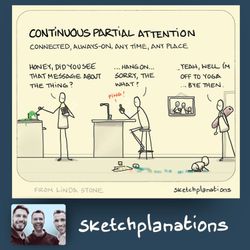
5. Continuous Partial Attention
38:38||Season 5, Ep. 5Coined in the 1990s by Linda Stone, Continuous Partial Attention describes the state of being constantly connected; trying to do multiple things at once, which often leads to an ever-present, low-level form of stress. We explore how this phenomenon affects modern life, compare it to multitasking, and discuss both its positive and negative aspects. The podcast also highlights how technology has exacerbated this issue and considers potential solutions, such as mindfulness and turning off notifications, to better manage one's attention.Links to stuff we discussed:Dan KahnemanMind Over TechVideo of Woman who Walks into Fountain Whilst TextingThe Film: Her, starring Joaquin Phoenix.Other Sketches and podcast episodes referenced:Phubbing episode and sketchPhone Zombie sketchHegel's Dialectic: Thesis, Antithesis, Synthesis sketchYak Shaving episode and sketch5 Ways to Wellbeing episode and sketchEveryone's a Geek About Something episode and sketchHow to Instantly Feel Better episode and sketchPicking the Perfect Present episode and sketchBuy Jono's Book: Big Ideas, Little Pictures, for a loved one this Christmas - The Perfect Present and then some...Summary00:00 Introduction to Continuous Partial Attention01:31 Depicting Continuous Partial Attention in a Sketch04:25 Personal Experiences with Continuous Partial Attention05:54 The Impact of Technology on Attention08:49 Multitasking vs. Continuous Partial Attention11:15 The Challenge of Staying Focused17:05 The Role of Continuous Partial Attention in Different Professions20:38 The Dilemma of Turning Off Notifications21:15 Balancing Work and Family Life22:03 The Art of Multitasking22:59 The Pitfalls of Continuous Partial Attention23:49 Turning Cognition into Automation25:25 The Rise of Single Tasking27:54 The Productivity of Focused Work32:07 The Future of AI and Continuous Partial Attention34:20 Final Thoughts and RecommendationsAll music on this podcast is provided by the very talented Franc Cinelli.
4. Microlives & The Art of Uncertainty with Sir David Spiegelhalter
53:47||Season 5, Ep. 4What's your life expectancy trade-off for enjoying a crispy bacon sandwich? 🥓Sir David Spiegelhalter is a celebrated Professor of Statistics at the University of Cambridge; widely accepted as one of the UK's foremost statisticians. He explains the concepts of 'micromorts' and 'microlives', which quantify risk and the impact of lifestyle choices on life expectancy. The discussion delves into acute vs. chronic risks, with practical examples such as the dangers of skydiving or how regular smoking affects longevity of life. The conversation also covers the application of statistics in medicine, the importance of randomisation in clinical trials, and the philosophical underpinnings of uncertainty. Additionally, David highlights the human capacity to judge risks, the pitfalls of intuition, and offers practical advice on dealing with uncertainty in everyday life. Lively anecdotes, insightful explanations, and practical takeaways make this episode a compelling listen for anyone interested in the intersection of statistics, risk, and daily decision-making.David's latest book, The Art of Uncertainty is available in all good bookshops and online.Here are some useful links to further explore some topics raised:The work of Ron Howard at Stanford UniversityJono's sketch on Word SpectrumsDavid's many other books - including Sex by NumbersPoisson Distribution explainedDavid tells the tale of Persi Diaconis - the Mathemagician.Episode Summary:00:00 Introduction, David's Background & Achievements01:43 The Wipeout Experience03:13 Understanding Micro-Morts04:27 Acute vs. Chronic Risks05:29 Micro-Morts in Everyday Activities12:05 Introduction to Micro-Lives18:03 Medical Applications of Data and Statistics21:27 The Role of Uncertainty in Life27:52 Building Resilience Over Robustness29:18 Embracing Uncertainty in Life33:35 Misuse of Statistics in Media and Politics40:30 The Gamblers Fallacy and Intuition42:29 The Uniqueness of Card Shuffles45:43 Common Misconceptions About Probability48:02 Practical Tips for Dealing with Uncertainty51:33 Final Thoughts and ReflectionsAll music is provided by Franc Cinelli.