Share
Stories From Glasgow
Overtourism
Season 4, Ep. 1
•
Make sure your seat belt is fastened and your chair is in the upright position for take-off; we’re heading to Mallorca with Dr Guillem Colom-Montero.
Mallorca has long been a popular holiday destination, but what are the consequences of that popularity? From representation in art and culture, to conversations with local communities and changes in vocabulary, Dr Colom-Montero joins Cia to reflect on the impact decades of tourism has had on the island – and some similar effects seen closer to home, here in Scotland.
More episodes
View all episodes
5. The Literature of the Impossible
58:51||Season 5, Ep. 5There's no better place to study and research Fantasy than Glasgow. As the 10th cohort of Fantasy MLitt students graduate and the Centre of Fantasy & the Fantastic celebrates its 5th anniversary, we’re celebrating the literature of the impossible in the podcast’s season finale. Professor Dimitra Fimi, Professor Matthew Sangster, Dr Will Tattersdill and Dr Anna McFarlane join the podcast for a fantastic conversation across media, and spanning centuries of literary history. From what makes fantasy so compelling to myths and misconceptions; we delve into the depths of Booktok and fandom, explore the publishing industry and AI futures, as well as touch on the many texts that inspired their research – not to mention the fantasy texts you need to read. You don’t need to be a fantasy reader to enjoy this episode, but you will be by the end credits. Discover the UofG Centre for Fantasy & the FantasticMeet Professor Dimitra Fimi, Professor Matthew Sangster, Dr Will Tattersdill and Dr Anna McFarlane, and find out about their researchLearn more about the Fantasy MLitt and how you can apply Follow @UofGFantasy on social media: Instagram, Bluesky, and X Check out the UofGFantasy YouTube channel to watch recordings from recent events and discover research from Centre members.
4. Atomic Legacies & Gamifying World Crises
48:19||Season 5, Ep. 4In summer 2025, the world marked the 80th anniversary of the atomic bombings of Hiroshima and Nagasaki. Dr Tim Peacock returns to the podcast for an episode reflecting on the legacy of the bombings; from their immediate impact on Japan and the growth of nuclear culture in the US, to international relations and nuclear diplomacy in the decades after. In the second half of the episode, Dr Peacock shares two games he has developed in the UofG Games & Gaming Lab which are centred around global nuclear and humanitarian crises: Dial N for Nuclear and HOPE AGE. Listen to find out how these games challenge players, as well as HOPE AGE’s impact when it was played by delegates at the United Nations earlier this year. Learn more about Dr Tim Peacock & his research Follow Dr Tim Peacock on X and Bluesky: @DrTimPeacock and @drtimpeacock.bsky.socialRead Dr Peacock’s articles for The Conversation UK on Godzilla and the cinematic legacies of the first nuclear tests, Oppenheimer, and Eisenhower’s Atoms for Peace speech.Discover the UofG Games & Gaming LabFollow the UofG Games & Gaming Lab on X and Bluesky: @UofGGamesLab and @uofggameslab.bsky.socialExplore research in the Scottish Centre for War Studies & Conflict ArchaeologyFollow the Scottish Centre for War Studies & Conflict Archaeology on X and Bluesky: @UofGWarStudies and @uofgwarstudies.bsky.social
3. Uncovering Kelvin Wheelies
34:54||Season 5, Ep. 3Countless stories could be told about Kelvingrove Park and its ever-evolving role in Glasgow’s 850-year history and the lives of the city’s residents. In the early 1980s, it was home to Kelvin Wheelies, a skatepark once hugely popular with local teenagers and professional skateboarders from across the UK alike. Now, it lies hidden, buried at the heart of the park with few traces to signal its existence. Dr Kenny Brophy joins Cia on the podcast to discuss the story of Kelvin Wheelies, recounting its place in the city’s modern sporting history, and in the memories of Glasgow’s skaters. He highlights the role of contemporary archaeology, and the methodologies archaeologists can use in order to explore events and sites from recent memory. In summer 2025, Dr Brophy led a team of archaeologists, students, volunteers from Archaeology Scotland’s New Audiences project, and former Kelvin Wheelies skaters to excavate the skatepark. Listen to find out what they discovered… Learn more about Dr Kenny Brophy and his researchhttps://www.gla.ac.uk/schools/humanities/staff/kennethbrophy/ Visit Dr Brophy’s blog, The Urban Prehistorianhttps://theurbanprehistorian.wordpress.com/ Follow Dr Brophy on X @urbanprehisto: https://x.com/urbanprehisto Find out more about Kelvin Wheelies & the excavation https://www.gla.ac.uk/colleges/arts/aboutus/news/headline_1204406_en.html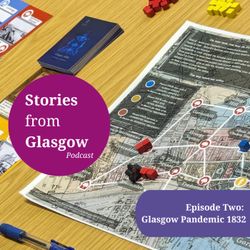
2. Glasgow Pandemic 1832
46:56||Season 5, Ep. 2In 2020, Glasgow entered lockdown and life changed dramatically as the COVID-19 pandemic spread across the globe. However, this was not the first time in the city’s 850-year history that a serious disease impacted Glasgow residents, as 1832 saw an outbreak of cholera spread across the city. Dr Matthew Creasy and Dr Megan Coyer join Dr Cia Jackson on the podcast to share the story of Glasgow’s 1832 cholera outbreak, and how it inspired their version of the popular boardgame, ‘Pandemic’. Listen to discover the impact cholera had on Glasgow and its residents, and Glasgow’s role in medical history. Find out more about Dr Matthew Creasy and his research: https://www.gla.ac.uk/schools/critical/staff/matthewcreasy/ Dr Creasy’s George Moore, Confessions of a Young Man: https://www.mhra.org.uk/publications/jt-5 Find out more about Dr Megan Coyer and her research: https://www.gla.ac.uk/schools/critical/staff/megancoyer/ Dr Megan Coyer’s James Hogg Contributions to Fraser’s Magazine for Town & Country https://edinburghuniversitypress.com/book-contributions-to-fraser-s-magazine-for-town-and-country.html Keep up to date with Glasgow Pandemic 1832: https://www.gla.ac.uk/research/az/mhrc/impact-and-engagement/glasgow-pandemic-1832/ Learn more about the Medical Humanities Research Centre at the University of Glasgow: https://www.gla.ac.uk/research/az/mhrc/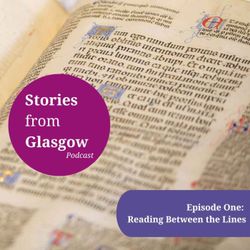
1. Reading Between the Lines
42:40||Season 5, Ep. 1There have long been heated debates about how we treat our books – and what is and isn’t permissible amongst readers. Do you use an old receipt as a bookmark, or simply fold down the corner of a page? How about highlighting or adding sticky tabs to your favourite passages, or even adding your reactions - in ink – to the margins? But what if rather than damaging the book, those additions increase its value and make it all the more precious? Dr Shanti Graheli, Senior Lecturer in Comparative Literature, joins Cia on the podcast for a conversation all about materiality, memory, and meaning, in advance of Book Tales, a series of engaging events celebrating books and their readers as part of the 2025 Being Human Festival. Dr Graheli shares how the value of books can extend far beyond their texts, forming connections between readers across borders and generations. Whether left by a beloved family member, or simply the book’s previous owner, inscriptions and annotations, make-shift bookmarks, or even torn pages taped back together can come together to tell the fascinating stories of readers past and present. Listen to learn more about Book Tales, and hear Dr Graheli’s manifesto as to why we should begin to leave written traces of ourselves in between the lines. Find out more about Dr Shanti Graheli and her research: https://www.gla.ac.uk/schools/mlc/staff/shantigraheli/ Check out the full line-up of Book Tales events as part of Being Human Festival 2025: https://www.beinghumanfestival.org/book-tales-storytelling-between-text-and-object Book your free tickets for the Book ‘Antiques’ Roadshow: https://www.beinghumanfestival.org/events/books-antiques-roadshow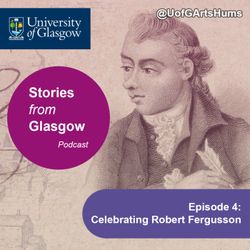
4. Celebrating Robert Fergusson
01:00:06||Season 4, Ep. 4Discover the Edinburgh poet who inspired Robert Burns, and whose impact extends well beyond the pages of his works to the city’s landscape, and even the treatment of brain injuries. ‘The Collected Works of Robert Fergusson: Reconstructing Textual and Cultural Legacies’ is a two-year research project, funded by the Leverhulme Trust, and led by Professor Rhona Brown. As the 250th anniversary of Fergusson’s death approaches, Prof. Brown and Dr Amy Wilcockson join the podcast to share their research, as well as insights into Fergusson’s life, works and legacy. Listen to learn more about Fergusson, and hear extracts of his work read by Billy Kay and James Robertson. Find out more about The Collected Works of Robert Fergusson: Reconstructing Textual and Cultural Legacies: https://robert-fergusson.glasgow.ac.uk/ Learn about upcoming events: https://robert-fergusson.glasgow.ac.uk/events/ Follow on X: https://x.com/RFergussonPoet Follow on Bluesky: https://bsky.app/profile/rfergussonpoet.bsky.social
3. Influencing Gaelic Publishing
54:06||Season 4, Ep. 3Join us as we go on a deep dive into Gaelic periodicals, publishing, and language with Dr Petra Johana Poncarová. Dr Poncarová introduces two figures who have played key roles in Gaelic publishing: Ruaraidh Erskine of Mar and Derick Thomson. From poetry and periodicals that spanned decades, to detective fiction, drama, and even a biology text book, listen now to find out more…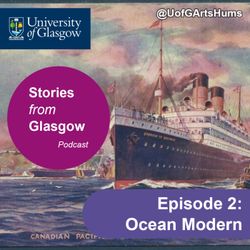
2. Ocean Modern
41:24||Season 4, Ep. 2Join us as we set sail on a voyage that spans the literary and historical; exploring the fascinating, glamorous – and sometimes dark – world of the ocean liner in Professor Faye Hammill’s Ocean Modern research project. Professor Hammill shares how the power and public fascination with the ocean liner has been captured in literature; and how real ocean liners - some even built on the Clyde – along with their crews and passengers – have been documented, commemorated, and mythologised. Join Professor Hammill and Cia as they explore literature, archival material, and even the role played by Glasgow’s own shipyards.