
Latest episode

80. At The Coalface with Writer Cat Connor
01:04:20||Ep. 80LD80: At the Coalface with Cat ConnorNew Zealand crime and spy thriller writer Cat Connor joins Mark to explain how she went from traditional publishing to running her own imprint. Her first novel, Killerbyte, sold to a publisher that went bankrupt a week before release. Her next publisher, Rebel, put her early books at the top of the charts, but its sales dropped after the company was sold to American owners. She then led a group of about 35 authors in getting their rights, covers and edited manuscripts back, and she now publishes all 27 of her books through 9mm Press. Cat explains why a new author can self-publish for almost nothing: free ISBNs from KDP or Draft2Digital, no business registration needed, interiors formatted in Apple Pages, and covers built in Canva over KDP’s cover template. She describes her editing chain from beta reader to editor to proofreader, and how she tests an editor before hiring one. She also covers launching at her local library, the marketing that actually sells books (Facebook ads, press releases and an email newsletter), audiobooks narrated by AI voices, and why she doesn’t fear AI copying an author’s voice. Her rule for all of it: it has to be fun, and if it isn’t, pay someone else to do it.A note on copyright for US listeners: Cat is right that copyright exists once a work is written down, and New Zealand has no registration system at all. In the United States, though, a work has to be registered with the US Copyright Office before you can sue for infringement. Statutory damages and attorney’s fees are only available if you registered before the infringement or within three months of publication. Registration is optional but cheap, and it’s done online. See the Copyright Office’s Copyright Basics (Circular 1) and its registration portal. This is general information, not legal advice.Cat Connorcatconnor.com: the FBI-Byte series, the Veronica Tracey Spy/PI series, the Fates Entwined trilogy, and the upcoming Indigo Delta KiloThe Big Thrill: “Yeah Noir”, an overview of Cat’s series and New Zealand noirThe Big Thrill: Foxtrot Foxtrot SierraThe Big Thrill: Up Close with Cat Connor, on the end of the Byte seriesISBNs and distributionKDP ISBN help: Amazon’s free ISBN for print booksDraft2Digital: free ISBNs and wide distribution beyond AmazonBowker / MyIdentifiers: buying your own ISBNs in the USAuthors Guild on KDP’s three-titles-per-day limitEditing and formattingApple Intelligence Writing Tools: the proofreading tool Cat uses in PagesGrammarlyVellum and Atticus: dedicated formatting software, which Cat says you don’t needCoversCanvaKDP paperback cover template and calculatorAudiobooksACX: royalty-share narration with professional voice actors, which isn’t open to New Zealand authorsKDP Virtual Voice: Amazon’s AI-narrated audiobooksApple Books digital narration, which Cat used for the Byte series through Draft2DigitalMarketing and launchMailchimp: Cat’s newsletter platformSubstackNational Pen: merch and pensPledgeMe: New Zealand crowdfundingSources:catconnor.comUS Copyright Office Circular 1Authors GuildPublishers WeeklyApple AuthorsKDP Help
More episodes
View all episodes

79. Harry Stourton's First Person View in Ukraine
43:48||Ep. 79Filmmaker Harry Stourton joins Mark from Kyiv, the morning after a heavy night of Russian strikes, to describe a war that has changed almost entirely since 2022. Stourton has produced feature films and documentaries, including Pizza Under Fire, which follows international volunteers who drive a converted truck into Ukraine’s eastern frontline villages to cook and hand out free pizzas. The film won Best Feature Documentary at the Sydney Liftoff Film Festival in 2025. He has been embedded for a year with a foreign FPV drone team for a new film. His reporting on foreign volunteers recruited for their gaming skills appeared in The Independent and a recent piece about Chernobyl appeared in The Spectator “Wilderness and war are changing Chernobyl forever” Episode 79.ReferencesHarry Stourton: Pizza Under Fire (Journeyman Pictures) · Where to watch · IMDb · “These gamers are now fighting for real in Ukraine’s war against Russia,” The Independent via AOLBridges: Drones hit Kyiv’s Southern Bridge on October 1 and 2 and the Northern Bridge on October 3, the first strikes on the city’s Dnipro bridges of the war. Sources: Meduza · CNN meduzaJet-powered Shaheds: Russia has produced three jet versions, the Geran-3, 4 and 5. They fly at up to 6 to 7 km altitude, and monthly launches rose from 350 in June to 2,800 in August. Sources: IEEE Spectrum · Euronews · Militarnyi, on Ukraine’s interceptor tests ieeeNova Poshta: A January ballistic-missile strike on the company’s Kharkiv terminal killed four employees. Sources: Interfax-Ukraine · NV, August strikes interfaxGas stations: Energy ministry data count more than 300 stations attacked since the current wave began. Sources: Euromaidan Press · Kyiv Independent euromaidanpressHESCO barriers (the “H” word Harry was reaching for): developed by former coal miner Jimi Heselden, who founded Hesco Bastion Ltd in 1989. Source: Wikipedia WikipediaAir-raid apps: “Air Alert” (Povitryana Tryvoha), launched in 2022 by Ajax Systems and Stfalcon, has more than 46 million downloads. Sources: Radio Moldova · war-monitor live map radiomoldovaTimothy Snyder: His Yale course, The Making of Modern Ukraine, is free on YouTube and as a podcast on Apple and Spotify. Sources: Yale course page · Yale News yale
78. Michael Sellers' Moscow Memories
45:46||Ep. 78Michael Sellers spent a decade as a CIA case officer, with postings in Eastern Europe, Africa and Asia. He landed in Cold War Moscow in 1984 under diplomatic cover where uhe worked on the Tolkachev operation - subject of the new film Billion Dollar spy starting Russell Crowe coming out soon. Sellers was first recruited into the CIA after studying film at NYU. In Moscow he also ran a KGB counterintelligence officer, Sergey Vorontsov, who handed him a sample of the KGB’s chemical surveillance tracking powder — “spy dust” — at a park meeting in April 1985. Sellers served twenty-one months as an extremely street-active officer before being arrested and expelled in March 1986 during a covert meeting with Vorontsov. He has since become a writer and filmmaker and, since 2023, a criminal defense and civil rights investigator. He publishes the Substack Deeper Look, a prolific evidence-based read on intelligence, current events, and the stories behind the headlines. michaeldsellers.com
77. Stephen Long Drops Into 1949 Albania
55:30||Ep. 77LD077: In June 1949, the CIA and MI6 secretly agreed to overthrow Albania's communist dictator Enver Hoxha. The operation — codenamed BGFiend — would use exiled Albanian dissidents, paramilitary infiltration, propaganda broadcasts from a yacht in the Adriatic, and a network of émigré communities in Rome, Athens, and West Germany. It ran for four years. It failed almost completely. Historian Stephen Long spent seven years in the CIA's declassified archive working through 6,700 pages of operational files — files that also contained British intelligence reports MI6 never intended anyone to see. What he found upends the standard explanation. BGFiend wasn't killed by Kim Philby. It was penetrated from the start by Italian naval intelligence, which had fully mapped the operation's émigré networks before the first agent crossed the border. The Albanian security service — the Sigurimi — was young but learning fast, supported by a ruthless political leadership and an informant network that reached down to the village level. Agents were dropped by parachute with minimal training, often miles from their target locations. They hid by day, moved at night, and were hunted by pursuit brigades, civilian militia, border guards, and regular police simultaneously. When Apple team radio operator Prenzi was captured, he did everything he could to signal that the operation was blown — including transmitting with his left hand after breaking his right arm escaping from prison. The CIA didn't want to believe it. Nine more men went in. Long argues BGFiend wasn't reckless — it was the West's painful apprenticeship in covert action, a template for everything that followed, from Poland to Ukraine to the Bay of Pigs. The lessons were eventually learned. Just not in time to save the men already in the field. Stephen Long is author of A Rich Harvest of Bitter Fruit: CIA and MI6 Covert Action in Communist Albania at the Dawn of the Cold War (Icon Books, 2026) https://www.iconbooks.comFurther ReadingRory Cormac, How to Stage a Coup: And Ten Other Lessons from the World of Secret Statecraft (Atlantic Books, 2022)https://www.atlantic-books.co.ukRichard J. Aldrich, GCHQ: The Uncensored Story of Britain's Most Secret Intelligence Agency (Harper Press, 2010)https://www.harpercollins.co.ukRichard H. Immerman, The Hidden Hand: A Brief History of the CIA (Wiley-Blackwell, 2014)https://www.wiley.comTim Weiner, Legacy of Ashes: The History of the CIA (Doubleday, 2007)https://www.penguinrandomhouse.comDavid Smiley, Albanian Assignment (Chatto & Windus, 1984)https://www.worldcat.org/title/albanian-assignmentOn the Sigurimi and AlbaniaBlendi Fevziu, Enver Hoxha: The Iron Fist of Albania (I.B. Tauris, 2016)https://www.bloomsbury.comAlbanian Authority for Access to Information on Ex-Sigurimi Fileshttps://www.aidssh.gov.al
76. Jack Beaumont on Memory and the French DGSE
48:24||Ep. 76Jack Beaumont, a former DGSE (French external intelligence) operative, focusing on Beaumont's experiences, his writing process, and the themes of his espionage novels. Beaumont explains that his writing began as a therapeutic exercise to cope with PTSD from his intelligence work, initially not intended for publication. He emphasizes the importance of memory and meticulous detail in his novels, a habit developed from years of writing exhaustive mission reports for the DGSE, which required both objective intelligence and subjective, sensory-rich accounts. This attention to detail, including smells and sounds, shapes the immersive quality of his books.Beaumont discusses the psychological toll of intelligence work, particularly the challenge of maintaining multiple identities and the difficulty of returning to normal family life after missions. He describes how operatives often develop a 'dark side' to manipulate and recruit sources, sometimes leading to moral injury and high rates of divorce and suicide among operatives. He notes that PTSD in intelligence work is not just about trauma from danger, but also from ethical dilemmas and the manipulation or destruction of innocent lives for the sake of national security.The conversation explores the differences between the DGSE and agencies like the CIA and MI6. Beaumont highlights the French focus on human intelligence (HUMINT), rooted in the legacy of the French Resistance, as opposed to the American emphasis on technical intelligence (SIGINT, COMINT) due to larger budgets and resources. He explains the 'MICE' framework (Money, Ideology, Coercion, Ego) for recruiting sources, and the ethical complexities involved, especially when coercion or blackmail is used as a last resort. France's DGSI data sharing and reliance on Palantir software is a continuing point of debate over information sovereignty. Beaumont also touches on the use of AI in writing and intelligence. He expresses skepticism about AI's ability to replicate the nuance and authenticity of human memory and creativity, noting that AI-generated translations and narratives often lack the depth and accuracy required for his work. He uses AI only sparingly, mainly for translation assistance, and finds it inadequate for creative writing.Throughout the interview, Beaumont shares anecdotes about real-life inspirations for his characters, the challenges of translation, and the camaraderie and personal stories of his colleagues. He reflects on the enduring appeal of the Templar Knights among operatives, symbolizing a code of honor and sacrifice. The discussion provides a rare, candid insight into the realities of modern espionage, the personal costs of intelligence work, and the evolving threats and ethical questions facing those in the field today.The Frenchman, Jack BeaumontDark Arena, Jack BeaumontBelmondo's Le Professionelmarkvalley.substack.com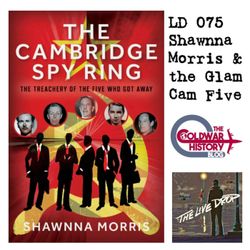
75. Shawnna Morris and the Glamorous Cambridge Five
57:20||Ep. 75In this interview, I had the pleasure of speaking with a Cold War expert--Shawnna Morris--about her fascinating book on the Cambridge Five spy ring. We talked about how her book has been received both in the UK and the US, and she shared some insights into the cultural attitudes around this famous espionage group. Shauna guided me through the recruitment storyline, explaining how Philby, McLean, Burgess, Blunt, and Cairncross became Soviet spies, and the social dynamics that let them operate undetected for so long. We explored the complicated personalities of each member—especially Philby’s evolution from idealist to, uhm, sociopath, and the betrayals that marked their personal lives. We also discussed how the legacy of the Cambridge Five continues to influence not just intelligence services, but also the way the story is told in books, films, and archives over time. Shauna reflected on the moral ambiguity at the heart of their actions and how new information continues to shift the narrative. Finally, she shared her excitement about her next project: a book focusing on extraordinary women in Cold War history. Websites:https://coldwarhistoryblog.com/https://coldwarbookreviews.wordpress.com/https://shawnnamorris.com/Here are her socials:https://www.facebook.com/CambridgeSpyRing/https://www.facebook.com/coldwarhistoryblog/https://www.facebook.com/ShawnnaMorrisAuthor/https://www.instagram.com/thecambridgespyring/https://www.instagram.com/coldwarhistoryblog/https://www.instagram.com/shawnnamorrisauthor/https://x.com/CambridgeSpiesThe book is available at Pen and Sword https://www.penandswordbooks.com/9781036108687/the-cambridge-spy-ring/and all major online retailers like Amazon, Barnes and Noble, etc.References:Films about the Cambridge Five across the decades...Philby, Burgess, and MacLean (1977)Blunt (1983) An Englishman Abroad (1987)A Spy Among Friends (2022)
74. James Stejskal: Author, Soldier, Snake-eater, Spy
41:56||Ep. 74This episode of The Live Drop, I talk with James Stejskal — a former U.S. Army Special Forces operator from Detachment “A” in Cold War Berlin who later worked in intelligence before turning to history and fiction. He’s the author of Special Forces Berlin and the Snake Eater Chronicles, and his latest books — The Ratcatcher and The Berlin Spy Guide — bring that same mix of lived experience and deep research. We dig into The Ratcatcher, a Berlin spy novel that fuses counterintelligence, crime, and military thriller — following the murder of a CI officer and the hunt for a U.S. traitor--the premise of which comes from a real case buried deep in the Stasi files. James talks about class and culture inside Cold War espionage — Ivy League analysts versus scrappy gumshoe operators — and what it really took to recruit sources behind the Wall. We also get into his research adventures in the archives, Berlin’s Cold War landmarks including a McDonalds, and how today’s Russia mirrors old Soviet tactics through imperial nostalgia and opportunism abroad.James StejskalBerlin Spy GuideRatcatcher of Berlin