Share
EQUALS: Reimagining Our Economy
COST OF LIVING STORIES ACROSS THE GLOBE – from Lumbadzi, London and Cape Town
We speak to three people reckoning with today’s massive cost of living crisis – with stories from Malawi, the United Kingdom and South Africa. Max speaks with Nellie Kumambala, a secondary school teacher in Lumbadzi, Malawi, and Walter, a security guard in London, United Kingdom. Nabil speaks with Wafaa Abdurahman, the National Coordinator, Fight Inequality Alliance South Africa.
Different countries, same story. People are suffering. They’re ready to act. What are their solutions?
Make sure you share the podcast on social media and leave a review! We’re at @EQUALShope on Twitter.
The views expressed on episodes do not necessarily represent the views of the podcast and its producers.
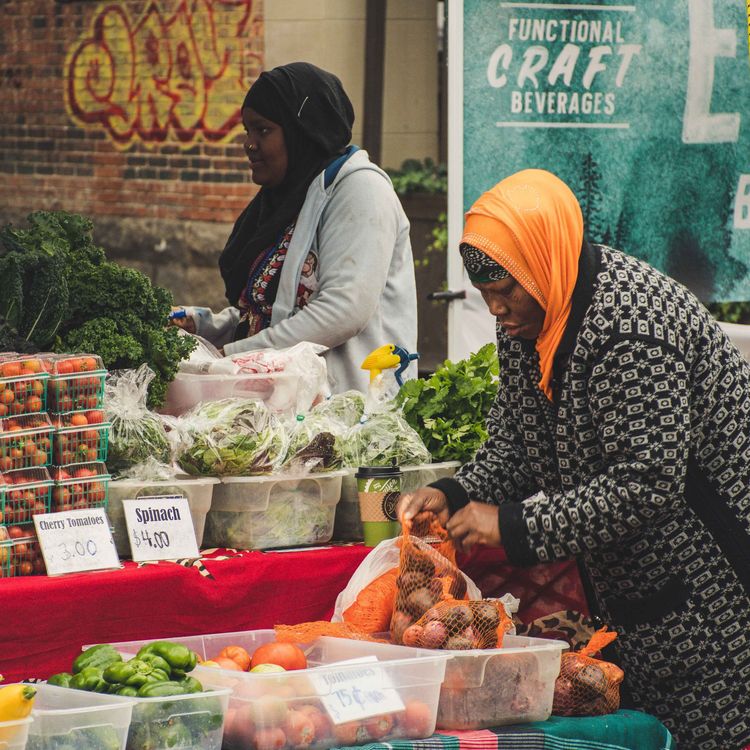
Women picking fruits: Photo by Brett Sayles
Don't just listen, join thousands of others reading our weekly digest on inequality. Sign up at https://www.equals.ink/
More episodes
View all episodes
25. The Global Justice Blueprint: A Roadmap to Equality, Shared Prosperity and Climate Justice
30:27||Season 8, Ep. 25Following our conversation with Olivier De Schutter on A Roadmap to End Poverty Beyond Growth, this episode concludes our two-part series exploring bold roadmaps for a just and sustainable future.Too often, climate breakdown and economic inequality are treated as separate crises. But what if they're two sides of the same problem, and one cannot be solved without confronting the other?In this episode of EQUALS, Nafkote Dabi and Max Lawson speak with Anmol Somanchi, Moritz Odersky, and Cornelia Mohren from the World Inequality Lab about the Global Justice Report, an ambitious blueprint for building an economy that delivers shared prosperity while keeping global warming within planetary boundaries.We explore the report's most radical proposals, including a Global Justice Fund financed through progressive global wealth and income taxes, with wealth tax rates of up to 20% for billionaires and top income tax rates of up to 90% for the world's highest earners. The authors argue that these measures could dramatically reduce extreme concentrations of wealth, progressively bringing an end to the billionaire class while financing investments in clean energy, healthcare, education, and sustainable development around the world.The conversation also wrestles with the inevitable criticisms. Is such a transformation politically possible? Can societies move beyond an economic model built on endless growth? And how do we build public support for climate action that improves people's lives rather than asking them to bear the costs of a crisis they did little to create?GuestsAnmol Somanchi is an Indian economist, researcher, and PhD candidate at the Paris School of Economics. He is the Global Justice Coordinator at the World Inequality Lab.Moritz Odersky is an economist and research fellow at the World Inequality Lab.Cornelia Mohren is an economist, Environmental Coordinator at the World Inequality Lab, and a PhD candidate in Economics at Sciences Po Paris.
22. Beyond Growth: Can We End Poverty Without GDP?
27:57||Season 8, Ep. 22For decades, governments have measured success with GDP growth. But even with years of economic expansion, poverty persists, inequality is growing and climate crisis is worsening. In this episode, we speak with Olivier De Schutter, the UN Special Rapporteur on Extreme Poverty and Human Rights, about his groundbreaking roadmap to end poverty without relying on endless GDP growth. Drawing on years of country visits and a global collaboration involving hundreds of economists, academics, unions and civil society organizations, Olivier argues that governments have become trapped by an obsession with growth at the expense of people's wellbeing.Together, we unpack why rising GDP hasn't stopped inequality from deepening, how extreme wealth concentration is undermining democracy, why "business-friendly" policies often leave people behind, and what a post-growth economy focused on meeting human needs could actually look like.Join us for a conversation that challenges one of the biggest assumptions in economics and offers a bold vision for a fairer future.This is the first episode in a two-part EQUALS series exploring some of the most ambitious ideas for building a fairer and more sustainable future. Next, we'll examine the World Inequality Lab's groundbreaking Global Justice Report, speaking with members of the team behind the report about their bold proposals to transform the global economy and confront inequality, climate change and global injustice.
21. The Fight for First Nations Justice in Australia: how inequality and indigenous rights are intertwined
31:26||Season 8, Ep. 21For many Indigenous communities, inequality is not simply about income or opportunity. It is about power, representation and land.In this episode, Nafkote Dabi and Max Lawson speak with Larissa Baldwin-Roberts, a Widjabul Wia-bal woman, climate justice advocate, and one of Australia's leading campaigners for First Nations rights.Drawing on her experience working across Indigenous justice, refugee rights, and climate advocacy, Larissa explores how structural racism continues to drive economic inequality for Indigenous peoples, not only in Australia but around the world.From the fight to reclaim January 26 as a day of truth-telling, to the growing influence of far-right politics, climate negotiations, and the challenge of building genuinely community-led movements, Larissa explains why inequality cannot be separated from questions of race, history, and power.The conversation also examines what meaningful inclusion really looks like, why Indigenous peoples are rights holders rather than stakeholders, and how building broad coalitions for justice may be essential to confronting today's intersecting crises.If we want a fairer economy, Larissa argues, we must first reckon with the systems that continue to exclude those on the frontlines of inequality.If you enjoy the episode, please like, share, comment, and leave us a review. Follow us on X @EQUALShope, Bluesky and on LinkedIn.
20. The Privatization of Education and Plunder of Common Goods
31:15||Season 8, Ep. 20What happens when basic public goods become a private, paid for service, education becomes a profit-turning treadmill and meanwhile millions live in chronic insecurity?In this episode Max and Grazielle interview renowned economist Guy Standing, exploring his argument that the privatization of public goods or what he calls the “plunder of the commons” has produced a new global class, the Precariat, and fuelled rising inequality.Guy explains why a basic income is a matter of common justice, freedom, and security, which are human rights. He further dives into his most recent book that describes how private equity and financialization have transformed schools and universities into profit machines, and why restoring the education system with slower, ethical, democratic learning matters for society.From privatized education to the future of basic income, this episode is a timely conversation about inequality, insecurity, and what it will take to build systems that serve people instead of profit.If you enjoy the episode, please like, share, comment, and leave us a review. Follow us on X @EQUALShope, Bluesky and on LinkedIn.
19. Muskism: How Big Tech Is Reshaping Power, Politics, and Democracy
31:50||Season 8, Ep. 19This week on EQUALS, we explore “Muskism” — the growing power of tech billionaires and what it means for democracy, inequality, and the future of society.Authors Quinn Slobodian and Ben Tarnoff argue that Elon Musk is not just a billionaire entrepreneur, but a sign of a deeper transformation in capitalism, technology, and political power.From AI and social media to electric vehicles, digital infrastructure, and government dependence on private tech companies, the episode asks what happens when essential systems are controlled by a handful of corporations and billionaires.We discuss the rise of “sovereignty as a service,” the growing influence of Big Tech over public life, and whether societies can reduce their dependence on tech monopolies while building more democratic alternatives.Later in the episode, Hana Ivanhoe joins the conversation to unpack who loses most in this new tech order — and what it would take to reclaim power in an increasingly unequal digital world.If you enjoy the episode, please like, share, comment, and leave us a review. Follow us on X @EQUALShope, Bluesky and on LinkedIn.
18. War, Oil, and Inequality: Who Wins and Who Loses
25:24||Season 8, Ep. 18In this episode, Adam Hanieh explains why crises like war, financial shocks, and pandemics don’t stay where they start. They move through the structures of the global economy. He explains how the effect of the Middle East war is going to move beyond borders through energy prices, food prices and security and consequently high cost of living, hitting the poorest of the population the hardest. Drawing on the aftermath of the 2008 financial crisis and the COVID-19 pandemic, Adam shows how these shocks consistently deepen inequality, hitting the most vulnerable hardest.He unpacks the central role of the Gulf countries in global supply chains, from oil and gas to fertilisers and industrial materials, and how disruptions in the region can drive inflation, strain food systems, and raise the cost of living worldwide.The conversation also explores the risks of continued dependence on fossil fuels, and why responding to these interconnected crises requires international cooperation rather than fragmented, national responses.
17. The Inequality Emergency: The Case for an International Panel on Inequality
25:00||Season 8, Ep. 17In this episode, we move beyond measuring inequality to examine how it is lived and experienced by people who are affected by it and why that distinction matters for policy.Dr. Wanga Zembe-Mkabile, social policy expert and one of the Founding Committee members of the International Panel on Inequality (IPI), brings a critical perspective often missing from economic debates: the human and embodied experience of inequality. Drawing on research in social determinants of health and epidemiology, she explains how the conditions people are born into shape not only income and opportunity, but health outcomes, life expectancy, and overall well-being.This conversation also challenges dominant ideas of meritocracy, showing how structural inequality predetermines life chances long before individuals can “compete.” It also explores why inequality is no longer just a development issue, but a global emergency with consequences for economic stability, personal well-being, security and trust in institutions.As momentum builds behind the International Panel on Inequality, this episode examines what a global, multidisciplinary body could mean for policymakers, governments, and the development sector. Can better evidence, and better framing, drive more effective action on economic justice?For economists, policymakers, and anyone working on inequality, this episode offers a deeper understanding of how inequality operates across systems—and why addressing it requires more than data alone.This is the second episode in a short series on the International Panel on Inequality. In our previous episode, we were joined by Isobel Frye and Katy Chakrabortty on the process of making the IPI and what aims to achieve. If you enjoy the episode, please like, share, comment, and leave us a review. Follow us on X @EQUALShope, Bluesky and on LinkedIn.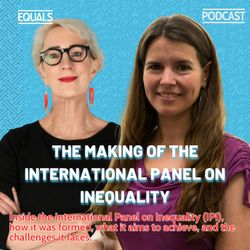
16. The Making of the International Panel on Inequality
19:11||Season 8, Ep. 16From rising billionaire wealth to dying public services, the gap between who has and who doesn’t is widening almost everywhere. Costs are climbing, and for millions, economic security is slipping further out of reach. And for once, there’s broad agreement, from the G20 to the UN to leading economists. The diagnosis is in. Inequality is no longer a side issue—it’s the issue.In this episode, we explore a bold new proposal from a panel of leading experts from around the world, chaired by Professor Joseph E. Stiglitz: International Panel on inequality (IPI), something similar to the Intergovernmental Panel on Climate Change (IPCC), but focused on economic inequality. The idea is to bring together the best global evidence, track progress, and give policymakers a clearer, shared foundation to act on one of the defining challenges of our time.But building a global response to inequality is not a small task. It means navigating politics, coordinating across countries, and turning knowledge into action in a world that doesn’t always agree on the solutions. What could a panel like this realistically achieve? And what might it change about how we understand and tackle inequality?At a time when faith in global cooperation is shaky and multilateralism is under strain, this could be a serious step forward and a test of whether the world is ready to act on inequality at the scale the crisis demands.This is the first episode in a short series on the International Panel on Inequality. In the next episode, we’ll be joined by Dr. Wanga Zembe-Mkabile, a member of the founding committee of the IPI, to take the conversation further.If you enjoy the episode, please like, share, comment, and leave us a review. Follow us on X @EQUALShope, Bluesky and on LinkedIn.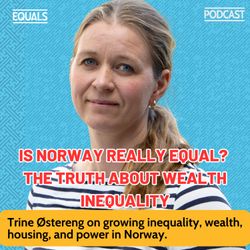
15. Is Norway Really Equal? The Truth About Wealth Inequality
23:48||Season 8, Ep. 15Norway is often seen as one of the most equal countries in the world. But is it really?In this episode Trine Østereng unpacks the reality behind the reputation, and the answer is uncomfortable. While some aspects of Norwegian society, like incomes, remain spectacularly equal, wealth at the top is becoming increasingly concentrated, giving a small elite outsized economic and political power. For example, just 10 people in Norway own more wealth than the bottom 50%.From a housing system that is locking young people out of ownership, to rising poverty and the reappearance of food lines, this conversation reveals how inequality is growing in ways that are harder to see but impossible to ignore.This episode also explores the political battles behind Norway’s wealth tax, how billionaires push back, and why tackling inequality isn’t just about lifting people out of poverty but also limiting the extreme wealth and power at the top.If you enjoy the episode, please like, share, comment, and leave us a review. Follow us on X @EQUALShope, Bluesky and on LinkedIn.Trine Østereng is an advisor at Think Tank Agenda and has been a host of the podcast Ut i Verden (Out in the World). She is also the author of the book Dangerous Differences: Why Great Economic Inequality Is a Social Problem