Share
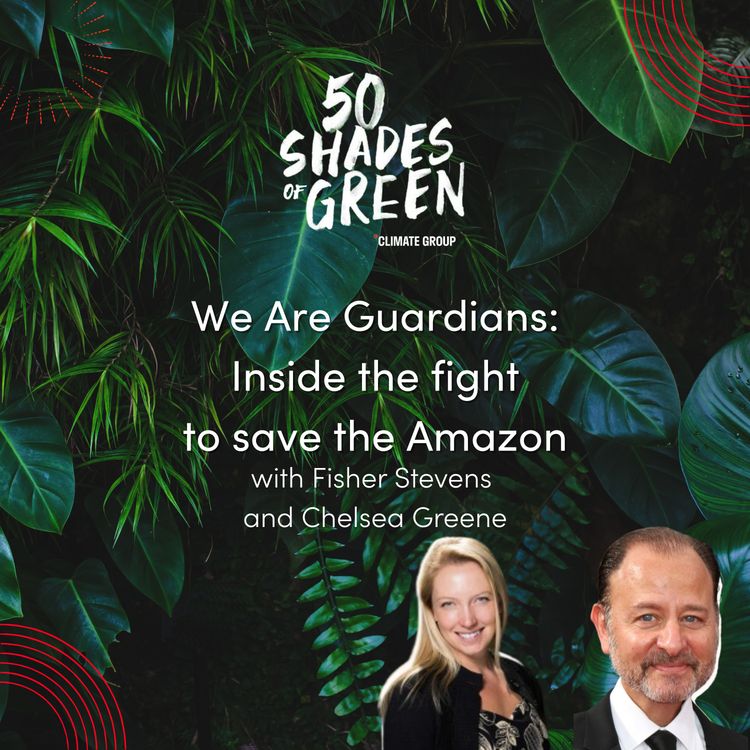
50 Shades of Green: A Climate Group Podcast
We Are Guardians: Inside the fight to save the Amazon
What does it take to protect the Amazon when your life is on the line?
In this powerful episode of 50 Shades of Green, we sit down with Academy Award–winning filmmaker Fisher Stevens and forest guardian and co-director Chelsea Greene to talk about their urgent new documentary, WE ARE GUARDIANS.
The film follows Indigenous leaders, activists, and even loggers caught inside the world’s most dangerous environmental conflict—where illegal deforestation, corporate interests, and climate change collide. From uncontacted tribes and frontline forest guardians to the global supply chains driving destruction, We Are Guardians reveals the human stories behind the Amazon crisis and why this fight matters to all of us.
We explore:
- The real risks facing Indigenous land defenders in the Amazon
- How documentaries can spark political and cultural change
- Concrete actions viewers can take, from boycotts to banking choices
- Why protecting the rainforest is inseparable from protecting humanity’s future
We Are Guardians premieres globally on Earth Day and streams worldwide across major platforms.
Listen now to understand why we are all guardians, and what’s at stake if we fail.
More episodes
View all episodes
Climate Week NYC: Is the US stepping up or stepping down?
41:39|In the final episode of 50 Shades of Green before Climate Week NYC, hosts Adam Lake and Katie Lanegran sit down with Angela Barranco, Executive Director of Climate Group North America, to cut through the noise about U.S. climate leadership.Is Climate Week NYC subdued this year? Has the United States checked out? Angela’s answer is blunt: patently false—and more complicated than the headlines suggest. While federal funding has slowed, companies, states, and cities are moving because the bottom line demands it. Insurance costs are rising, supply chains are at risk, and climate impacts are hitting workforces now. Texas, often cast as hostile to climate action, is the country’s top producer of clean energy and actively competes for investment. Action has not stopped; the language has simply broadened. Conversations once labeled “climate” now center on housing, health, food, energy bills, and the cost of living—the issues that shape everyday life.Angela unpacks the political calendar that will shape the mood on the ground: midterm elections in November that could flip Congress, upcoming gubernatorial races in California and New York, and the possibility of new federal leadership. She explains the real power of the Speaker of the House and highlights New York City’s new mayor, who is putting affordability, clean air, and energy efficiency at the center of the city’s agenda and helping launch the week with a housing-focused event.The hosts and Angela also look at Climate Week itself. Last year broke records. This year will be bigger still, with events across all five boroughs. Their practical advice: wear comfortable shoes, drink water, treat it as a marathon, “event surf” by talking to people, and get out of Midtown. Highlights include American Innovation Abundance Day at the Hub, live tapings of 50 Shades of Green, and a surprising mix of serious panels and joyful programming—whale watches, hockey, recycling tours, comedy nights, free Central Park bike rides, and solar going up on a historic Habitat for Humanity building.This episode is both a reality check and a field guide: the United States is still in the fight, the week will be massive, and the most useful conversations may not even use the word “climate.”
Why more beans means less emissions. Really.
47:51|Adam Lake and Katie Lanegran welcome Sarah Lake—no relation—founder and CEO of Tilt Collective, a philanthropy initiative working to make the most sustainable and healthy foods the most available and affordable. Recorded as Climate Week NYC approaches, the conversation lands on a topic filling the week’s calendar: food. Tilt Collective’s mission is a “balanced food system”: more whole foods, more plant-rich meals, fewer ultra-processed products and less overconsumption of animal foods. Sarah argues food is nearly a third of climate emissions yet is still sliced into fertilizer, land, and production debates instead of what we actually eat. The payoff is unusually broad—climate, water, public health, pandemic risk, antimicrobial resistance, and healthcare costs tied to diet-related disease. She traces her path from a childhood love of cows and summers on farms to a PhD on cattle supply chains in Colorado, corporate sustainability work, and a team question that reframed everything: instead of only greening beef, why not eat fewer animal products? That led to Tilt, which now re-grants to groups in nearly nine countries so companies and governments can shift menus in ways that are culturally appropriate. The episode is not a lecture on going vegan. Americans eat about six times the recommended amount of red meat; bringing intake toward guidelines would move climate and health at once. Sarah’s personal stake is visceral: at 11, her father needed six-way bypass surgery linked to a 1950s meat-and-potatoes diet—while the hospital’s main restaurant was a McDonald’s. Meat’s cheapness, she says, is policy: subsidies for feed and production make burgers cheaper than Brussels sprouts. Practical levers include blended products (a 60/40 beef-mushroom burger that testers often prefer), school and hospital procurement, chef training, food-service companies, and supermarket promotions that currently push meat. Beans, she notes, are having a moment; quinoa and kale already proved obscure plants can go mainstream. Culture is treated as a constraint and an asset: visit grandma and eat the pork; don’t fight Super Bowl wings head-on; help regions keep traditional beans and modest meat rather than import industrial diets. Tilt is Climate Week NYC’s lead food partner again and hosts Food Day on Wednesday the 23rd, aiming for alignment rather than plant-based vs. regenerative turf wars. Adam and Katie close on family kitchens, equity, and why choice only exists if healthy options are cheap and nearby.Find out more at https://tiltcollective.org/
Cooling as a Human Right
46:12|In this episode of 50 Shades of Green, hosts Adam Lake and Katie Lanegran speak with Christine Egan, CEO of CLASP, about energy-efficient appliances — from household ACs and refrigerators to off-grid fans and lights serving 660 million people without electricity.As extreme heat intensifies, Egan makes the case that cooling is becoming a human right, provided it is highly efficient. She outlines how minimum energy performance standards create a market floor while incentives and bulk buying pull products toward best-available technology. A standout success: leveraging the Minamata Convention on mercury to phase out fluorescent lighting in favor of LEDs, avoiding nearly three gigatons of CO2.Recorded ahead of Climate Week NYC, the discussion links kitchen-table energy bills, indoor air quality, and climate policy, showing why smarter appliances matter for health, livelihoods, and the planet. Tune in for a clear-eyed look at one of climate action’s most practical — and overlooked — tools.CLASP has a Find CLASP at New York Climate Week 2026 page to find out more, you can also catch them at the following Climate Week NYC events. Advancing Climate Action through Private Sector Collaboratives (Monday, 21 September, 3:30 - 4:20PM) Win-Win Policies: Unlocking Investment for a Sustainable Future (Tuesday, 22 September, 8:00 - 10:00AM) Powering Prosperity: Equitable Policy Design in the Global South (Wednesday, 23 September, 10:30AM - 12:30PM)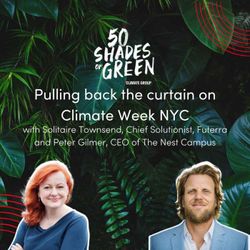
Pulling back the curtain on Climate Week NYC
50:08|This week Adam and Katie speak to some of the "mega hosts" who make Climate Week NYC the biggest climate event in the world. From fireside chats with Elmo, to bringing together the future of AI technology under one roof, Solitaire Townsend from Futerra - who run Solutions House - and Peter Gilmer from The Nest Campus talk us through what it is like to run some of the biggest events at Climate Week NYC, and how you can get involved.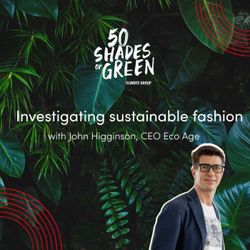
Investigating sustainable fashion
41:58|Adam and Katie are joined by John Higginson, CEO of Eco Age, moving the needle of sustainable fashion.Eco Age operates on two fronts. They educate consumers on positive, non-guilt-inducing choices. Separately, the organization funds independent investigative journalism into fashion’s supply chains—work traditional fashion media often avoids due to advertising dependence—while generating revenue as a consultancy for brands, material innovators, and organizations pursuing genuine sustainability.The conversation highlights fashion’s outsized footprint: roughly 2% of global GDP yet about 10% of climate emissions, plus water pollution from dyeing and widespread labor abuses, often in developing countries where some of the best progressive work is also happening.Show notes:Find out more at https://eco-age.com/Check out their Climate Week NYC event at https://www.climateweeknyc.org/event-search/convening-the-next-gen-materials-transition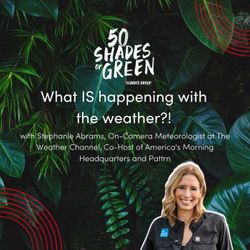
What IS happening with the weather?!
36:49|Is it time to bring back Smokey the Bear? In this episode of 50 Shades of Green, hosts Adam Lake and Katie Lanegran are joined by meteorologist Stephanie Abrams from The Weather Channel to find out just what IS happening with the weather right now. From heatwaves to wildfires, Katie and Stephanie talk through the reasons why the weather has been so extreme this year and the role that human made emissions have played in making it worse. They also explore what actions people should take to cope with extreme weather and what we can all do to be more resilient in the face of more frequent events. Asking the big question, what can people do to prevent climate change, Stephanie talks about the small things individuals can do to make a difference, as well as the major systemic changes which need to happen. Follow Stephanie at https://x.com/StephanieAbrams and https://www.weathergroup.com/shows/amhqThis episode is brought to you by Climate Week NYC. Climate Week NYC brings together over 1000 events and hundreds of thousands of people for the biggest climate event on the planet. If you are a non-profit, organization or company doing the right thing who has a story to tell, find out more about how you can be a part of the week. Find out more at climateweeknyc.org Partner with us: Partner with us at Climate Week NYCDelegate tickets for The Hub Live: https://www.climateweeknyc.org/attend-climate-week-nycSubmit your event here: Host a Climate Week NYC Event 2026 | Register Now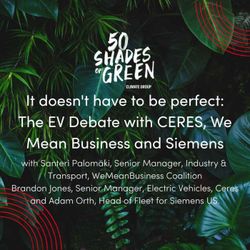
It doesn't have to be perfect: The EV Debate
01:06:22|In this episode of 50 Shades of Green from Climate Group, hosts Adam Lake and Katie Lanegran welcome back transport correspondent Ricky (Richard Parker) by popular demand for a deep dive into corporate fleet electrification. Fresh off the release of EV100’s annual Electric Realities Report, the conversation moves from high-level commitments to the practical realities of getting battery-electric vehicles on the road at scale. The episode features two rich interviews that map the full electrification journey. First, Ricky sits down with Brandon Jones from Ceres and Santeri Palomäki from the We Mean Business Coalition. They unpack complementary resources designed for companies at different stages. Ceres’ Driving Growth: Managing Transition Risks in Transportation report makes the financial and risk-management case for electrification—covering physical, market, and transition risks tied to fossil-fuel dependence, capital reallocation, and regulatory shifts. It stresses accounting for transport emissions across operations and value chains, securing leadership buy-in for science-aligned targets, developing time-bound EV strategies, and joining collaborative platforms such as Ceres’ Corporate Electric Vehicle Alliance (CEVA) and Climate Group’s EV100. Santeri walks through We Mean Business’s freely available Business Action Checklists (including a dedicated India edition). The second interview features Adam Orth, Head of US Fleet at Siemens. Siemens has electrified 50% of its roughly 8,000 US vehicles—spanning light-duty sedans, SUVs, pickups, medium-duty assets, and even early heavy-duty tractor trailers and yard spotters across every climate and geography. Adam shares how the company shifted from asking “which EV should we buy?” to “what does the job actually require?” That mindset unlocked operational redesigns: many small vans were carrying far less payload than assumed (or mostly air), leading to right-sizing into more suitable models (including a phased transition via ICE Equinoxes that prepared teams for the EV versions). Drivers now operate smart vehicles with one-pedal driving, advanced safety features, and 300–400+ mile ranges that meet real duty cycles.Adam is candid about remaining gaps—especially medium-duty vans with high payload needs—and the value of peer networks (EV100 and CEVA) in aggregating demand so OEMs can close those gaps. Change management has been continuous: custom training videos, ongoing education even after a year of driving, and treating electrification as an opportunity to improve efficiency rather than a one-for-one fuel swap. His three pieces of advice for companies just starting: begin with the work (not the vehicle), don’t wait for perfect (electrify the easy routes first and learn), and don’t go it alone.Throughout, the hosts and guests emphasize that electrification is operational systems change—not merely swapping powertrains. It forces companies to re-examine payload, routing, gear, employee behavior, and fuel-price risk. The consistent message across NGO guidance and corporate practice is clear: start now, share lessons, and scale what works. Listeners leave with concrete entry points—whether they still need to win the internal business case, need a step-by-step checklist, or are ready to move from pilots to majority electrification.Resources mentioned include the EV100 Electric Realities Report (climategroup.org), Ceres’ Driving Growth report and CEVA, and We Mean Business Business Action Checklists. The episode closes with a look ahead to Climate Week NYC transport conversations (charging access, power availability, and vehicle affordability) and a preview of next week’s guest.Tune in for actionable insights from the companies and coalitions already proving that large-scale fleet electrification is not only possible—it’s underway.
Do we have a problem with Net-Zero?
58:17|In this episode of Fifty Shades of Green, hosts Adam Lake and Katie Lanegran sit down with Lisa Sachs, Director of the Columbia Center on Sustainable Investment and lead of Columbia’s M.S. in Climate Finance at Columbia Climate School, for a candid, wide-ranging conversation about net zero, carbon markets, and what it will actually take to decarbonize the global economy. Against a backdrop of record heat, wildfires, storms and smoky skies, the trio wrestles with a central question: has the language and practice of “net zero” helped — or distracted — the climate movement?Lisa opens by clarifying what net zero really means: an atmospheric goal to balance emissions and sinks. She argues that the way net zero has been popularized — as an entity-level target for companies, cities or countries — is misleading and often counterproductive. Rather than driving systemic decarbonization, entity-level promises too frequently rely on offsets and voluntary carbon markets, allowing emitters to claim neutrality without changing underlying systems. Lisa worries voluntary markets are largely driven by methodological flaws and middlemen profit, and that offsets cannot substitute for actual decarbonization everywhere. Adam and Katie push back and probe implications, including whether the net zero framing could be a cynical distraction — Lisa admits that while conspiracy is tempting, institutional inertia and misunderstanding of systems are more likely culprits.The conversation pivots to solutions-oriented thinking. Lisa is optimistic about the present moment: decarbonized systems for energy, transport, buildings and industry are now often cheaper, more resilient, and superior on performance — they are “better systems.” The barrier is not technology but coordination, planning, policy enablers and financing structures, especially in emerging markets. She emphasizes that while private capital can and should drive many transitions, nature and resilience must be treated as public goods requiring public finance. Rather than obsessing over terminology or expecting COP negotiations to design and implement systems, Lisa urges practical, sectoral, regionally tailored solutions developed in the year between COPs and then brought to the global stage for political validation and scale.Adam and Katie reflect on messaging and politics: why “net zero” has become a loaded phrase and how consumer-focused narratives (you must sacrifice) have undermined public support. They highlight the need to shift discourse toward the tangible, everyday benefits of better systems — cheaper energy, reliable grids, improved appliances, and jobs — drawing parallels with how LEDs and EVs moved from niche statements to mainstream, nonpartisan technologies. The hosts also discuss the role of fossil fuels in emerging economies and the unfair financing barriers that make leapfrogging to clean systems difficult; Lisa insists we should enable scalable, financeable clean infrastructure rather than concede fossil dependence.Throughout, the tone balances critique and constructive optimism: the net zero construct may be flawed, but the transition to a cleaner, fairer, more prosperous world is feasible and economically compelling. The episode closes with a call to reframe the work: focus on building the better systems we need, redesign financing and policy levers to unlock them globally — especially in fast-growing emerging markets — and use forums like COP to scale proven solutions rather than invent them.Listeners will come away with a sharper understanding of the limits of carbon offsets, a clearer picture of what “net zero” should mean, and practical hope: we know what systems to build, the barriers we must remove, and how collective, cross-disciplinary action can make a decarbonized future both attainable and beneficial for everyone.
Lions, Tigers and Elephant Poop.
44:00|In this episode of 50 Shades of Green, hosts Adam Lake and Katie Lanegran sit down with Naftali Honig, Regional Operations Manager for Africa Parks’ Congo's region, for a deep, hopeful conversation about the Congo Basin — its global climate importance, the wildlife it supports, and the practical work and challenges of protecting and restoring these critical ecosystems. The show opens with light banter about the World Cup, then quickly pivots to the episode’s focus: why the Congo Basin matters and how on-the-ground conservation is being done differently and successfully.Naftali explains the basin’s role as a global “lung” — not only in gas exchange and carbon storage but as a vast hydrological system that moves freshwater across Central Africa. He outlines the geography of the region, centered on the Democratic Republic of Congo but stretching into neighboring countries, and describes the remarkable biodiversity: forest elephants, gorillas, chimpanzees, myriad less-known species, and savanna-edge animals historically including cheetah. The conversation emphasizes that these ecosystems are interconnected and underpin global climate stability, water security, food systems, and local livelihoods.A major thread is African Parks’ approach: protected areas as anchors for a nature-based, sustainable economy that benefits both people and nature. Naftali debunks the myth that conservation in Africa is only about tourism, explaining how protected lands support sustainable fisheries, forestry, cultural heritage, and community wellbeing. He stresses local stewardship — most park staff are from surrounding communities — and argues that conservation succeeds when it empowers people economically and culturally, not when it excludes them.The episode highlights inspiring restoration work, notably the reintroduction of white rhinos to Garamba National Park in northeastern DRC. Naftali describes the complex logistics and long-term monitoring required for translocations, and how returning “ecosystem engineers” like rhinos can transform landscapes and accelerate ecological recovery. They also discuss plans to restore prey populations, antelopes, zebras, and potentially cheetah, illustrating how recovery must follow ecological sequencing and sustained management.Naftali outlines the principal challenges: ecological logistics and anti-poaching work, socio-political complexities, and, critically, finances. Tourism can help, but crises like Ebola and limited national budgets mean conservation needs diversified funding and innovative financial tools. He also points to technological advances — satellite imagery, tracking collars, and environmental DNA (eDNA) — that revolutionize how scientists monitor biodiversity and ecosystem health, offering richer, networked insights into species interactions and food webs.Practical takeaways for listeners include how to support the work: visit and respect rules as responsible tourists, donate to credible organizations like African Parks, and amplify the stories and science of conservation. The hosts reflect on misconceptions — especially the condescending “white savior” narrative — and celebrate the leadership and expertise originating in Africa. The episode closes on an optimistic note: real, measurable conservation successes prove that “nothing is impossible” when communities, governments, science, and sustained funding come together.Warm, informative, and grounded in field experience, this episode reframes conservation as a complex, people-centered enterprise with global stakes. It’s essential listening for anyone curious about how large-scale restoration works in practice, why the Congo Basin matters to all of us, and how targeted, locally driven efforts can yield dramatic ecological returns — from rhinos roaming again to forests stabilizing climate and water for generations to come.